About Androsace villosa L.
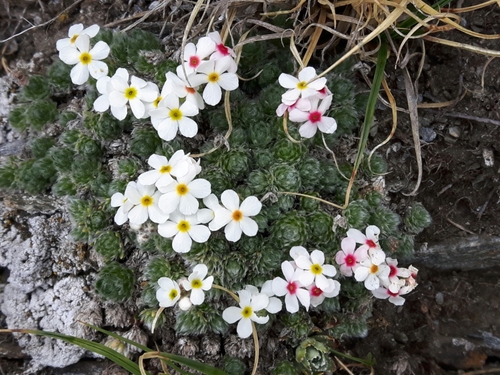
Androsace villosa L. is a highly variable species. The form most commonly grown in gardens is a small, tufted or mat-forming perennial, with leaf rosettes that reach up to 1.5 cm across. Its leaves are linear to elliptical in shape, and bear fine hairs on their undersides, with higher hair concentration toward the leaf tips. Flowers measure 6–10 mm in diameter, and are arranged in umbels held on stems that grow up to 3 cm tall. Flower colour ranges from white to red-purple, with a pink or yellow central eye; white-flowered forms may turn pink as they age. In the wild, Androsace villosa grows on limestone mountains in Europe and Asia, most often on rocky slopes at elevations above 1500 m. This species is widely cultivated for use in rock gardens, and several distinct varieties are grown in cultivation. Androsace villosa var. arachnoidea has a compact growth habit and more woolly leaf rosettes. Androsace villosa var. taurica, which has the synonym Androsace taurica, produces pink flowers with a red eye. Androsace villosa var. jacquemontii originates from the Himalayas at elevations above 3500 m; it is stoloniferous, and spreads to form large mats. Its leaves are more densely hairy, and its red-purple flowers have a greenish-yellow eye. This variety is sensitive to excess winter moisture.