About Androsace septentrionalis L.
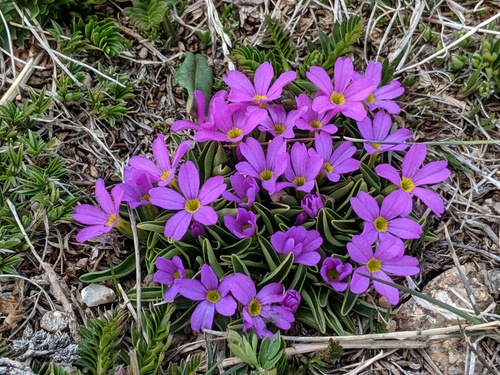
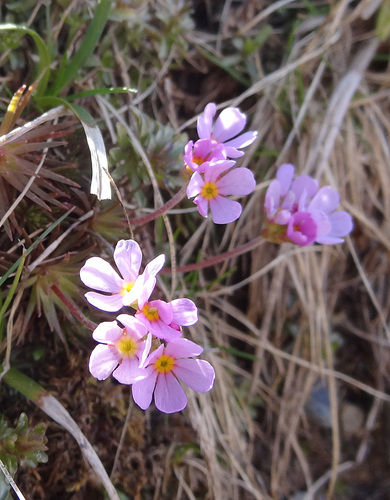
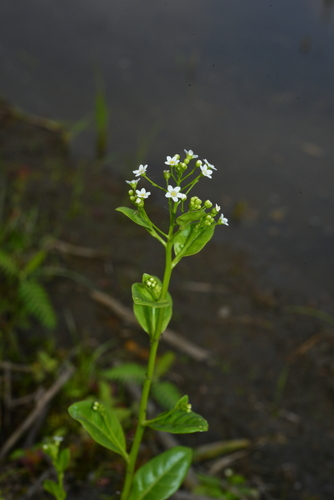
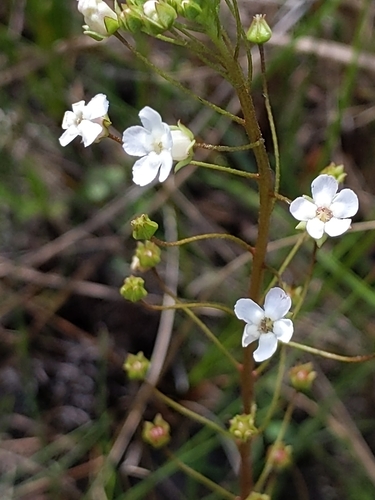
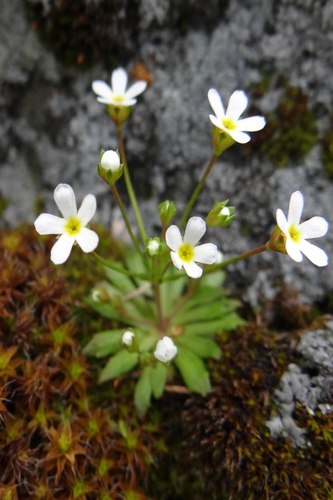
Androsace septentrionalis L. is a highly variable species in size, ranging from barely noticeable to relatively large, and it does not form mats. Plants of this species are either annuals or biennials, and all of their basal leaves grow in a single rosette. Leaves are attached by a very short petiole, or are sessile with no leaf stem at all. They are 5 to 35 millimeters long and 3 to 10 millimeters wide. They may be hairless or hairy, and are usually ciliate, meaning they have a fringe of hairs along the leaf margin. Leaf shape ranges from oblanceolate, like a reversed spear head, to spatulate, like a spoon. Plants usually produce 1 to 5 leafless floral stems called scapes, though they may occasionally grow as many as 10. Scapes are typically 1 to 10 centimeters long, and sometimes reach up to 30 centimeters. Each inflorescence holds between 5 and 30 small flowers. The flowers measure only 4–6 millimeters across, and have white or pink petals. The fruit is a 3 to 5 millimeter long capsule, which contains numerous seeds that are each 0.5 to 1 millimeter long. Androsace septentrionalis is a very widely distributed species native to North America, Europe, and temperate Asia. In Europe, it is native westward to France, but does not occur in the Low Countries or the British Isles. It grows widely across Central Europe, but is not present in Hungary. To the south, it occurs in Italy and Romania. To the north, it is part of the native flora of Denmark, the Scandinavian Peninsula, and Finland. It grows throughout Eastern Europe except for the Crimean Peninsula. Its range extends south as far as Georgia and neighboring Armenia. In western Asia, it is fairly widespread, growing in western Siberia, Altai Krai, Yakutia, and as far north as 72° N in the Novaya Zemlya archipelago. In Central Asia it is native to Kazakhstan, Kyrgyzstan, Uzbekistan, and Tajikistan. Further south, it extends into northern Pakistan and northwestern India in the Western Himalayas. In East Asia, it grows in northern Chinese provinces of Xinjiang, Inner Mongolia, and Hebei, as well as in the country of Mongolia. On the eastern side of Asia, it grows across the Russian Far East and also in Korea. The North American native population of this species occurs across the far north from Alaska to Greenland. It grows throughout Canada east to Quebec; it formerly occurred in Newfoundland but is now locally extinct there. In the contiguous United States, it is found in western states from the Pacific Coast east as far as Minnesota and Texas, and does not occur in the central or southern Great Plains states. In Mexico, it is native only to three northern states: Nuevo León, Coahuila, and Sonora. Androsace septentrionalis occurs in open areas, especially on sandy, gravelly, or disturbed ground. It can be found growing in tundra, forests, grasslands, and shrublands.