About Andricus quercuscalicis (Burgsdorff, 1783)
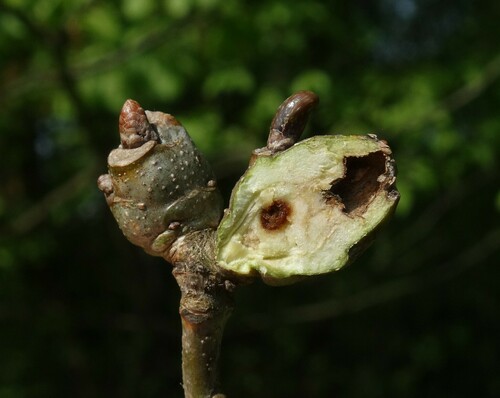
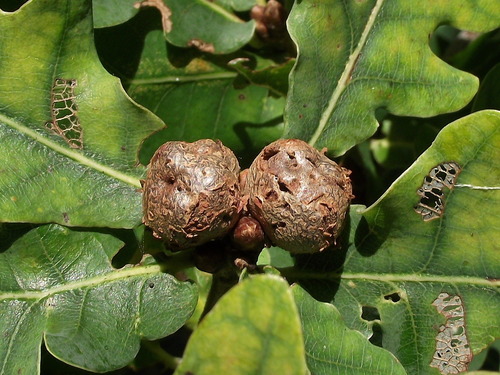
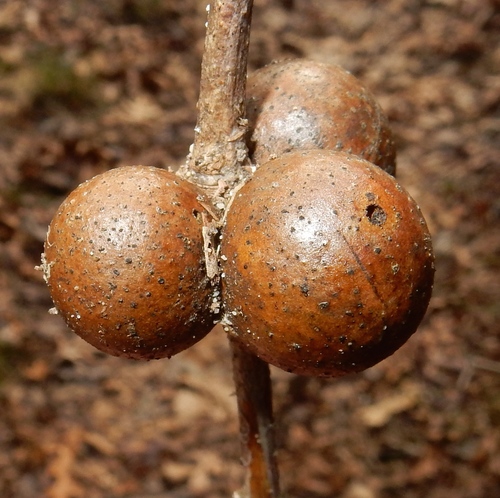
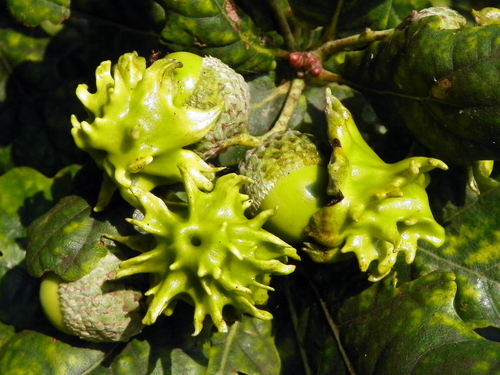
Andricus quercuscalicis (Burgsdorff, 1783) is a species of gall wasp that induces the formation of knopper galls. These galls are chemically induced distortions of growing acorns on pedunculate oak (Quercus robur L.) trees, formed after the gall wasp lays eggs into buds using its ovipositor. These galls can greatly reduce the fecundity of their oak host, making them potentially a greater threat to the tree’s reproductive ability than galls that develop on leaves, buds, stems, and other plant parts.
Andricus quercuscalicis originally had a range restricted to that of its required host Turkey oak, which is native to south-eastern Europe, because the wasp depends on Turkey oaks for reproduction. Since the 17th century, Turkey oak has been planted across the whole of Europe, which allowed Andricus quercuscalicis to expand its range. Records of this range expansion go back as far as 1631, when the species was recorded in eastern Germany. Great Britain and Ireland are the most recent areas the species has spread to.
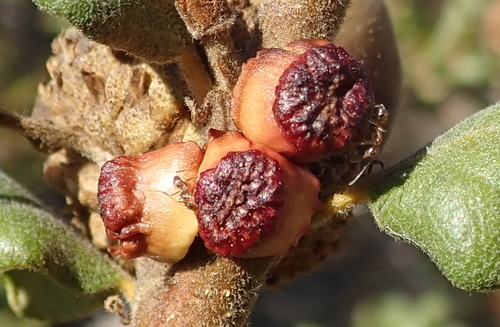
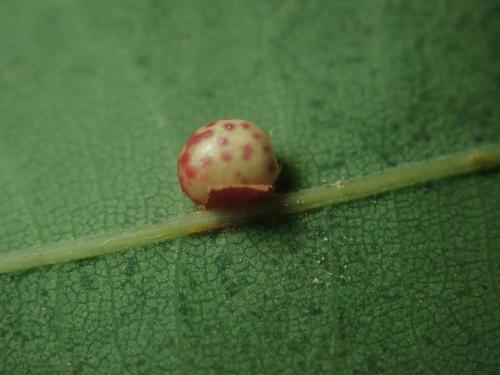
This small gall wasp, a member of the Cynipidae family within Hymenoptera, has an obligate two-phase life cycle that requires both pedunculate oak Q. robur L. (or occasionally sessile oak Q. petraea L.) and Turkey oak Quercus cerris L. The first phase of the life cycle takes place in spring, forming small conical galls on the male catkins of Turkey oak. In this phase, females produce both male and female offspring via parthenogenesis — they lay eggs without mating. The resulting bisexual generation mates, and females lay their eggs in autumn. The second phase, the agamic generation, develops in autumn on pedunculate oaks, forming the galls that are commonly called knopper galls.