About Andricus aries (Giraud, 1859)
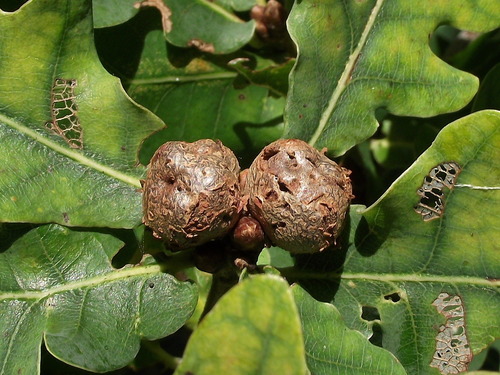
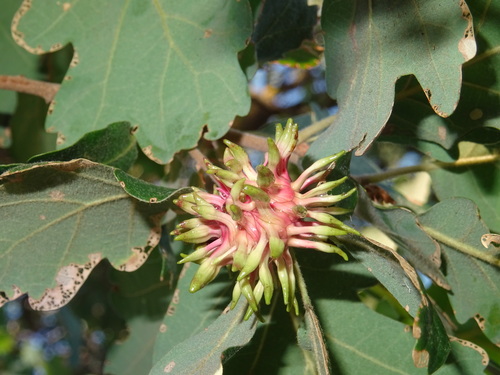
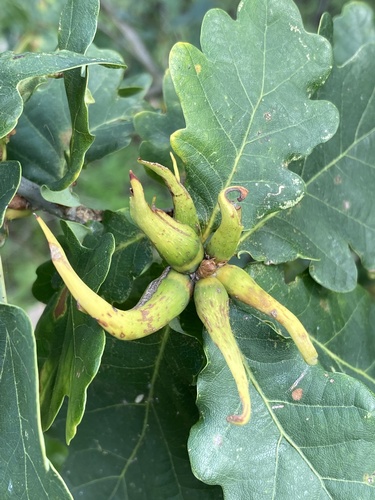
Adults of Andricus aries lay their eggs on multiple oak species, including Quercus robur, Q. petraea, Q. pubescens, and Q. cerris. Developing larvae trigger the tree to form an elongated gall that resembles a ram's horn, which inspired the specific epithet 'aries' and the common name 'ram's horn gall wasp'. When young, the gall is green; it may be as small as 5 mm long or reduced to a single strap. As it matures, the gall hardens and turns brown, and it becomes particularly variable in form when it contains inquilines from the genus Synergus. Andricus aries does not induce galls on acorns; instead, its galls develop on leaf buds of twigs, with variable forms caused by the activity of parasites and inquilines. The sexual generation of A. aries occurs on the catkins of evergreen oak. At least in northwestern Europe, the species only reproduces via asexual generations, though experiments have shown that newly emerged females will lay eggs into the axillary buds of Quercus cerris. Like other gall wasp species that have colonized the British Isles, A. aries has become used by native parasitoids since its arrival, and parasitoids from continental Europe have not followed the species across the English Channel. Andricus aries is primarily found in eastern Europe, but has spread to western Europe including the United Kingdom during the 21st century. It was first recorded in Maidenhead Thicket, Berkshire in 1997, and has since spread across the entire southern half of England.