About Andrias japonicus (Temminck, 1836)
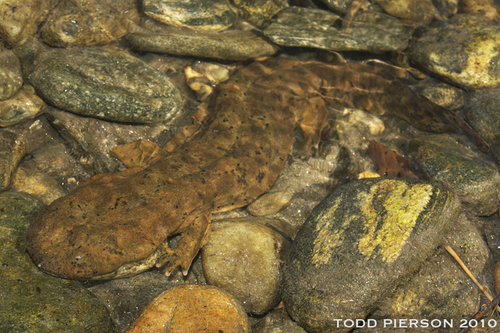
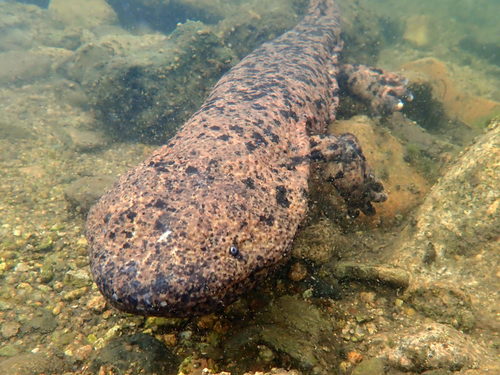
The Japanese giant salamander, scientifically named Andrias japonicus, can grow up to 5 feet (1.5 m) in length and 55 pounds (25 kg) in weight. The largest recorded wild specimen measured 4.46 feet (136 cm) long and weighed 58 pounds (26.3 kg). It ranks as the third-largest amphibian in the world, smaller only than its close relatives: the South China giant salamander and the Chinese giant salamander. This species has brown and black mottled skin that acts as camouflage against the bottoms of streams and rivers. Its entire body surface is covered with many small warts, with distinct clusters of warts concentrated on its head. It has very small eyes that lack eyelids, and it has poor eyesight. Its mouth stretches across the full width of its head, and can open to match the full width of its body. Andrias japonicus has large skin folds on its neck that increase its total body surface area. This increased surface area supports epidermal gas exchange, which regulates the exchange of oxygen and carbon dioxide with surrounding water. Capillaries located just below the skin's surface facilitate this gas exchange. Compared to the Japanese giant salamander, the hellbender has more pronounced skin folds along each side of its body. The Japanese giant salamander can be told apart from the Chinese giant salamander by the arrangement of tubercles on its head and throat. The Japanese giant salamander's tubercles are larger and more numerous, while the Chinese giant salamander has mostly single, irregularly scattered tubercles. The Japanese giant salamander also has a more rounded snout and a slightly shorter tail than the Chinese giant salamander. During the breeding season, adult males develop enlarged cloacal glands. Relative to its body size, an adult male typically has a larger, wider head than an adult female. Outside of the breeding season, it is difficult to tell males and females apart. The Japanese giant salamander is native to southwestern Japan, occurring west of Gifu Prefecture on Honshu, and in parts of Shikoku and Kyushu. Robust wild populations are confirmed to exist in Okayama, Hyogo, Shimane, Tottori, Yamaguchi, Mie, Ehime, Gifu, and Ōita Prefectures. In these regions, the species is typically found in fast-flowing mountain streams. It occupies freshwater habitats ranging from relatively large rivers 20 to 50 meters wide to small headwater streams 0.5 to 4 meters wide. Smaller breeding adults tend to occupy small headwater streams, likely to avoid intraspecific competition with larger individuals that live in larger streams. Mark-recapture data indicates that Japanese giant salamanders migrate between the mainstem and tributaries of the same river. Environmental DNA surveys followed by physical field surveys suggest small headwater streams are important habitats for juveniles and larvae. It has been hypothesized that the populations of Japanese giant salamander found in Wakayama Prefecture were introduced by humans, and it is still unknown if any naturally occurring native populations exist there. While habitat degradation poses a threat to the species, Japanese giant salamanders can live in disturbed streams bordered by agricultural land such as rice paddy fields. In these streams adjacent to rice paddies, adult Japanese giant salamanders often thrive: rice paddy fields support frog populations, which make up the primary diet for adult salamanders in this habitat. However, streams surrounded by rice paddies typically have agricultural dams and concrete stream banks, which negatively impact salamander reproduction and lead to low recruitment of new individuals.