About Andrena bicolor Fabricius, 1775
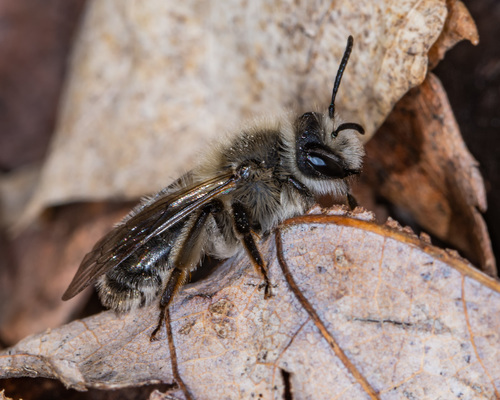
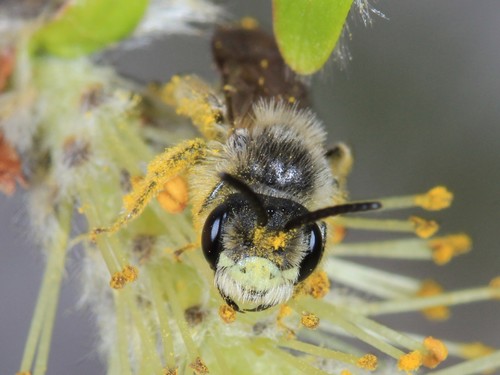
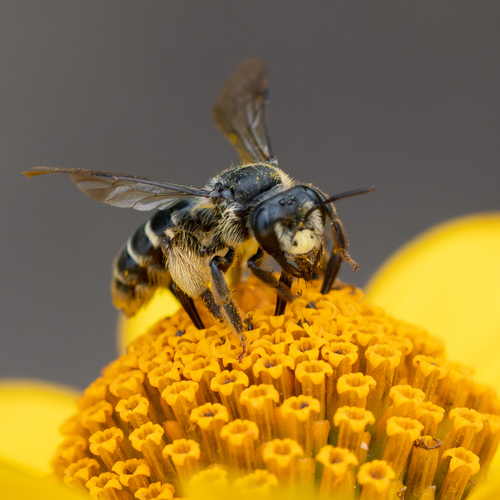
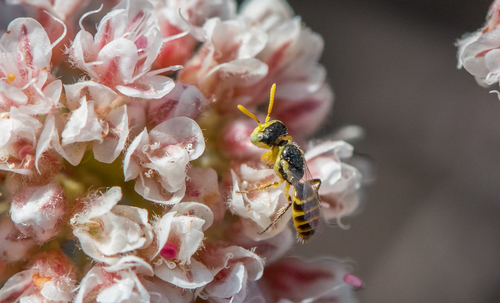
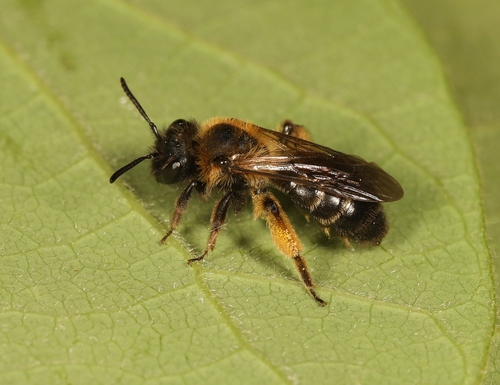
Andrena bicolor is a small to medium-sized mining bee, where males are slightly smaller than females. Females have a covering of reddish-brown hairs on the upper surface of their thorax, a completely black-haired face, and faint bands of yellowish hairs along the margins of the first through third abdominal tergites. Individuals of the spring brood can display extensive black hair on their femurs and the sides of the thorax, and this trait is far less prominent in the autumn brood. The species has dark hind tibias, which bear distinct orange hairs that have been described as resembling a pair of orange leg warmers. Males of the spring brood have black hairs on the head and sides of the thorax, and lack the bright colouration seen in females. By contrast, males from the summer brood often have brown hairs on the face and have no black hairs on the sides of the thorax.
Andrena bicolor is a widely distributed species across Europe. Its range extends from most of Great Britain and Ireland in the west, through southern Fennoscandia, and south to the Mediterranean. It occurs on the Mediterranean islands of Corsica, the Balearic Islands, Sicily, Crete and Cyprus, but is not found on Sardinia. The species' range extends eastward into Russia and Central Asia, and it has also been recorded in Turkey, Israel and Iran. In the Netherlands, it is more common in the south than the north, and appears to be expanding its range northward.
Andrena bicolor is a generalist in its habitat selection, occupying areas from calcareous grassland to open woodlands, and only avoiding closed-canopy woodland and high alpine habitats. In parts of its range, including Ireland and sections of Scotland, it can be a coastal species. In the Alps, it occurs up to 1,800 metres (5,900 ft) in Switzerland, and has been recorded as high as 2,100 metres (6,900 ft) in Austria. It is bivoltine, meaning it produces two broods per season: a spring brood that flies from March to June, and a summer brood that flies from June to late August. The first brood is much more numerous than the second, and the second brood is much more elusive than the first, particularly the males.
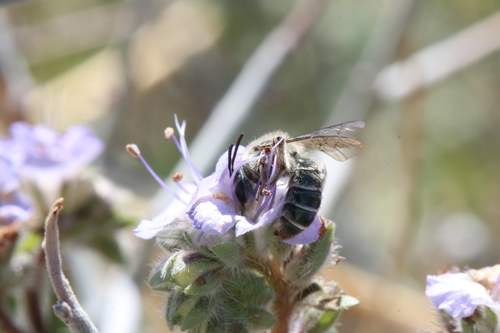
A. bicolor is polylectic, meaning it collects pollen and nectar from a wide variety of flowering plants, which has been confirmed by sampling pollen carried by females. The spring brood forages on a wide range of early-flowering plants, including low herbaceous species such as coltsfoot (Tussilago farfara), Bellis perennis, dandelions (Taraxacum spp), buttercups (Ranunculus spp), daffodils (Narcissus spp.) and bluebells (Hyacinthoides spp), as well as spring-flowering shrubs like hawthorn (Crataegus spp) and willow (Salix spp). Summer brood females mainly feed from bell flowers, especially harebell (Campanula rotundifolia) and clustered bellflower (Campanula glomerata), and also use other species including white bryony (Bryonia alba), blackberry (Rubus spp.), mallows, cranesbills and cinquefoils. In Ukraine, A. bicolor is considered one of the most important pollinators of cherry crops.
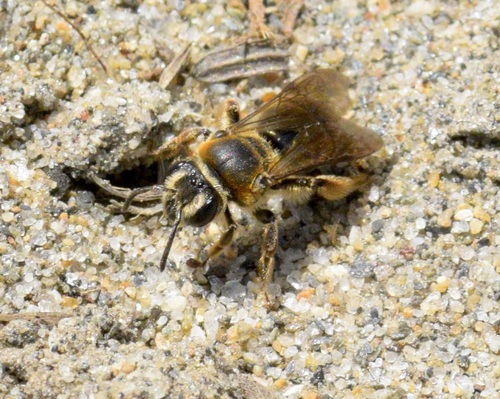
The nest tunnel of A. bicolor can be over 1 metre (3.3 ft) long. Nests may be solitary, or built in small loose aggregations, which are normally located on relatively bare ground on south-facing banks or slopes. In Germany, nests have been found alongside the nests of other Andrena species, including Andrena fulva and members of the Andrena minutula complex. Nests are rarely recorded and difficult to locate. The cleptoparasitic nomad bee Nomada fabriciana is a known associate of A. bicolor. The twisted-winged fly Stylops gwynanae may stylopise (parasitize) A. bicolor in Spain and eastern Europe, and larval Stylops have been observed on adult A. bicolor individuals.