About Andreaea rupestris Hedw.
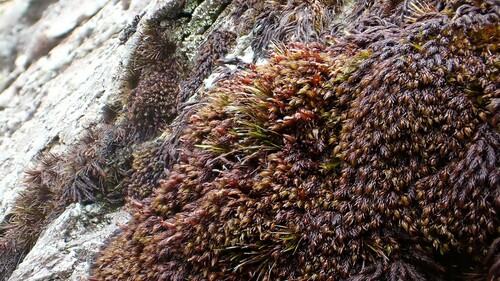
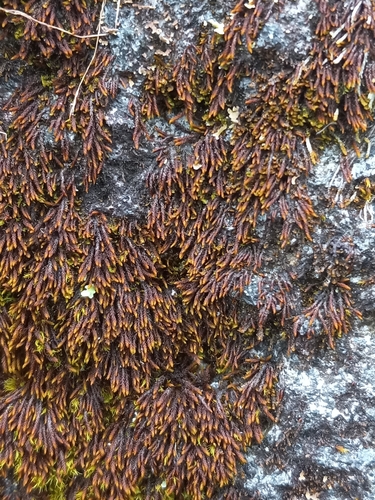
Andreaea rupestris Hedw. is a moss that is dark in colour, with shade varying from dark red, brown or green to black depending on its life stage. It grows in dense, cushion-like tuft patches that reach up to 2–3 cm high. When conditions are dry, its leaves are imbricate; in moist conditions, leaves may be falcate-secund, curved to one side, though this does not always occur. Unlike some other mosses, A. rupestris has biseriate rhizoids that help attach its gametophyte to the substrate. Andreaea rupestris is typically found in cooler climates on dry, siliceous, exposed rock surfaces or fissures such as granite. While it can also grow in neutral to mildly basic conditions, it is usually found growing on acidic rocks and cliff walls. It can occur from sea level to high elevations, but is more commonly associated with higher altitudes. Compared to other species in its genus, it can withstand a wider range of moisture levels and survives better in drier conditions. It has been found growing alongside other species of its genus: Andreaea nivalis, A. blyttii, A. rigida, A. crassinervia, A. rothii ssp. rothii, A. rothii ssp. jalcata, A. alpina, and A. obovata. It is primarily distributed across the Northern Hemisphere in North America, Europe, and Asia. Confirmed locations include Canada, the United States, Norway, Britain, Ireland, Kazakhstan, Korea, China, Japan, Central America, New Zealand, Antarctica, and most recently Greece in 2018. A. rupestris has a life cycle with alternating heteromorphic generations, made up of the sporophyte and gametophyte stages. The gametophyte stage starts from a haploid spore, which germinates into a thalloid protonema. The protonema then gives rise to the leafy gametophyte, which holds the male antheridia and female archegonia. Andreaea rupestris is autoicous, meaning its male and female organs are on separate branches within the same gametophyte. The close proximity of antheridia and archegonia facilitates fertilization. Antheridia produce sperm that travel down the neck of an archegonium, which holds the egg, to fertilize it. Once fertilized, the egg becomes a diploid zygote, which develops into a diploid sporangium. The sporangium attaches to a haploid pseudopodium that comes from gametophytic tissue. Through meiosis, haploid spores are produced and released through the gaps of the dehisced sporangium.