About Andreaea rothii F.Weber & D.Mohr
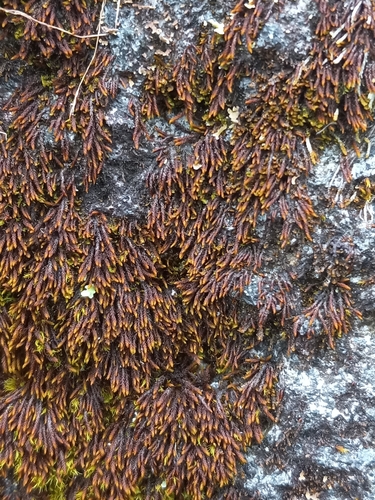
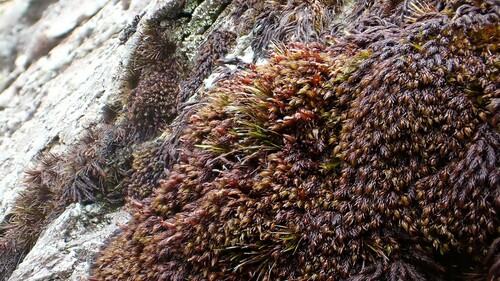
Andreaea rothii gametophytes sometimes form extensive black to brown cushion-like patches. Individual shoots are erect and shorter than 2 cm tall. Its leaves measure 1–2 mm wide, feature a strong costa, a structure roughly equivalent to a midrib, and can be falcate-secund, curving toward one side of the plant. This curved orientation is particularly prominent when the plant is wet, and the plant does not change much in appearance when dry. The leaf outline is pear-shaped, wider and swollen at the base, tapering toward the tip, and leaves may also be strongly curved depending on the subspecies. Andreaea rothii grows on wet, acidic, exposed rocks, and occurs from sea-level up to high elevation areas. Gametophytes of Andreaea rothii can be either gonioautoicous or cladautoicous. For gonioautoicous plants, antheridia grow as bud-like structures in the axil of an archegonial branch. For cladautoicous plants, antheridia and archegonia develop on different branches of the same individual. Like all members of the Andreaeaceae family, Andreaea rothii sporangia are held up by a pseudopodium, a structure that resembles a seta but is made of gametophyte tissue instead of sporophyte tissue. The sporangia split open lengthwise through longitudinal dehiscence, forming slits that allow spores to disperse. This dehiscence pattern gives the whole genus its common name of "Lantern mosses".