About Andigena laminirostris Gould, 1851
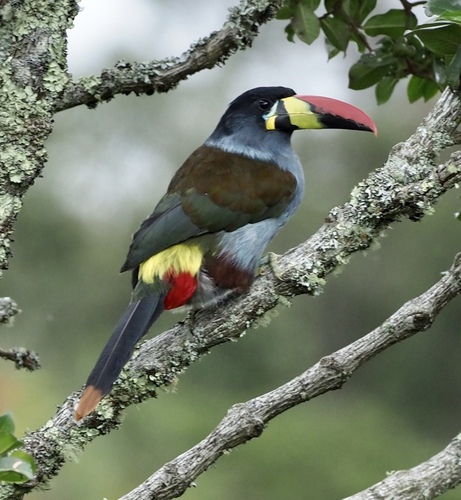
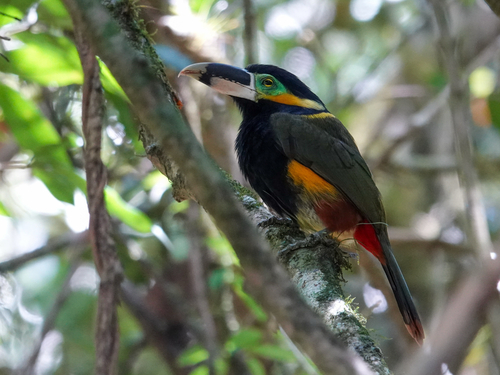
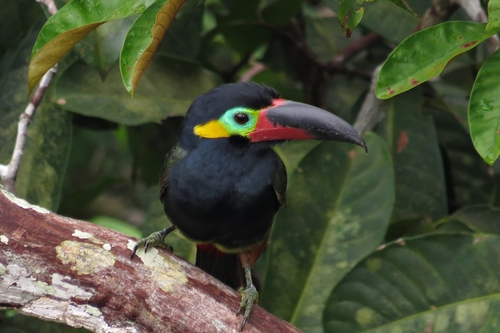
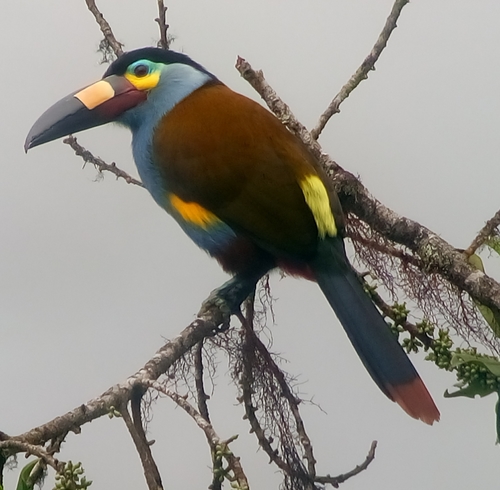
Plate-billed Mountain-Toucans (Andigena laminirostris Gould, 1851) have a large, laterally compressed bill. The front half of the bill is black, the back half is mostly red, and a raised yellow plate on the upper mandible is the unique feature that gives the species its name. They have a reddish brown iris and a bare area around the eye, which is yellow below and turquoise green above. Their crown and nape are black, and the rest of their upper body is bronzy olive. The sides of the neck and underparts are blue gray, with a yellow patch on the flanks that is partially covered by the wings. They have a yellow rump patch, a black tail with chestnut-colored tips, bright red crissum (the area around the vent), and brownish maroon thighs. This species measures about 42 to 53 centimeters (16.5 to 21 inches) in total length, with a relatively lightweight bill that can grow up to 10 centimeters long. On average, males weigh about 314 grams (11.1 ounces) and females weigh about 303 grams (10.7 ounces). It is zygodactylous, meaning it has two toes facing forward and two toes pointing backward. Plate-billed mountain toucans are distributed across the western foothills of the Andes in western Ecuador and far southwestern Colombia. In Colombia, their range extends from Pita Canyon (Narino) in southwestern Colombia south to the northwestern border of Ecuador's Morona-Santiago Province. They live in humid forest and the edges of temperate forest on the lateral slope of the Andes Mountains. These humid forests have abundant epiphytes, bromeliads, and mosses, receive an average of 14 feet of rainfall per year, and have a canopy that ranges from 6 to 10 meters high. Their typical altitudinal range is between 1600 and 2600 meters above sea level, and they have been observed several times at 3100 meters elevation in Imbabura, Ecuador. Due to their shared altitudinal range, plate-billed mountain toucans share their ecological niche with the Andean cock-of-the-rock. Their estimated total living area is 14300 km2. The plate-billed mountain toucan feeds mainly on fruit, and occasionally eats insects and eggs. It disperses the seeds of plants including the mountain understory shrub Faramea affinis and the palm Prestoea acuminata. There is one recorded observation of this bird eating a caecilian (Caecilia sp.).