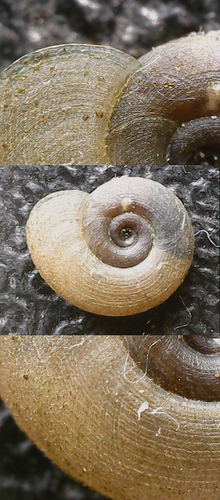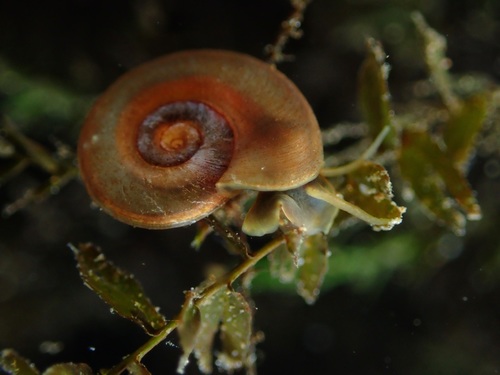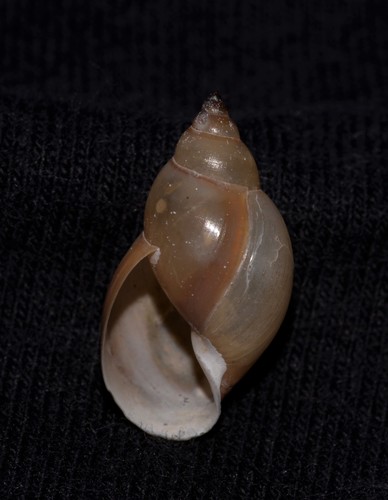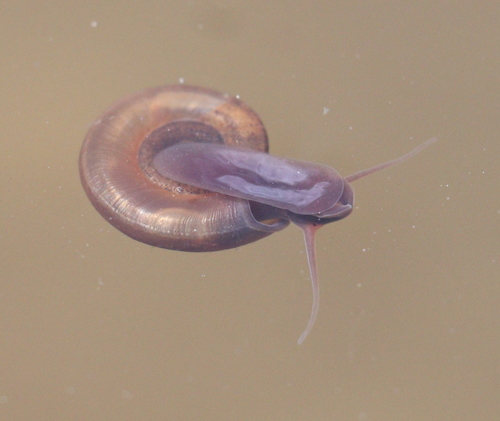
About Ancylus fluviatilis O.F.Müller, 1774
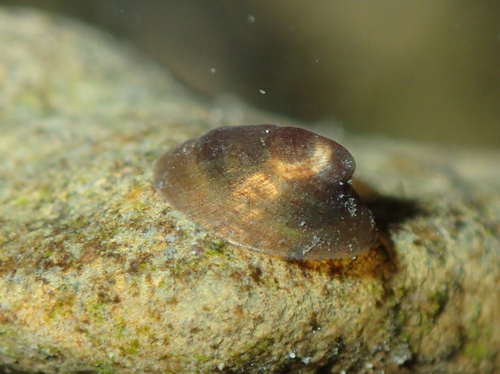
Ancylus fluviatilis O.F.Müller, 1774 has a limpet-like shell that measures 5–8 mm, with a backward-pointing conical apex. The shell is taller than the shells of Acroloxus and Ferrissia. When viewed from above, the apex is blunt, but it appears more pointed when viewed from the side. The shell curves backward and only very weakly toward the right side. It is thin and translucent, marked with reticulate sculpture and fine growth lines. Shell color ranges from light yellowish to reddish brown or dull pale brown. The animal itself is grey, with black dots near the head, and is almost entirely covered by the shell. Its tentacles are triangular, with eyes located at their base. The very small genital pore and pneumostome are positioned on the right side of the body. This species has an Eurosiberian Southern-temperate distribution. It is not yet clear whether various southern and eastern forms should be classified as separate independent species. It occurs in northern, western, and central Europe, specifically confirmed in Great Britain and Ireland, the Czech Republic, Germany, the Netherlands, Poland, Slovakia, and France; additional European distribution records can be found in Fauna Europaea. It is not found in northern Norway, southern Sweden, or Finland. In large portions of the Mediterranean region, including the Iberian Peninsula and Italy, there are distinct forms that molecular genetics have not yet confirmed as separate named species. Similar forms are also found in northeastern Africa: in coastal areas from Morocco to Tunisia, the Hoggar Mountains of Algeria, and the Ethiopian Highlands up to 2240 m above sea level. It has also been recorded in Saudi Arabia, Yemen, and the Caucasus (Armenia), but is not known to occur in the Afrotropical region. This freshwater limpet is a rheophile that inhabits oxygen-rich fast-running waters and karst springs. It does not live in waters that freeze over in winter. It requires a hard substrate with moderate algae growth that is neither too sparse nor too dense, which makes it frequent in rivers and streams across Central Europe. It also occurs in lakes in both North America and Western Europe. Unlike many other freshwater snail species, this animal tolerates base-poor acidic environments. Members of this species group from Southern Europe, North Africa, and the Middle East can survive exposure during periods of low water to some extent by forming a protective layer on the underside of their shell. Central European forms only have a limited ability to do this, but they can survive low water conditions by adhering firmly to the surface of stones.