About Ancylometes bogotensis (Keyserling, 1877)
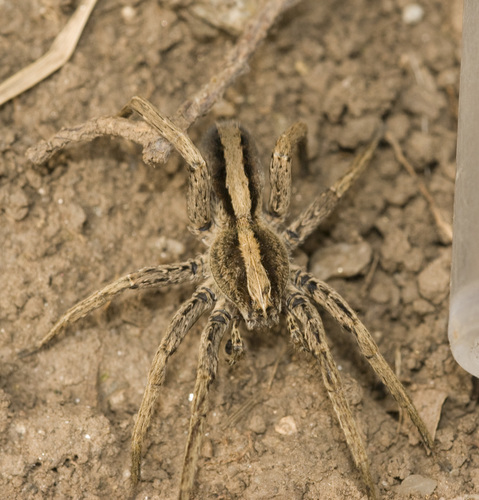
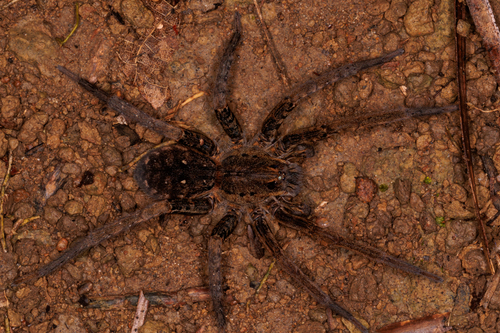
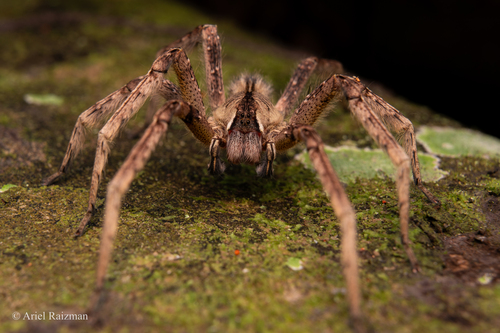
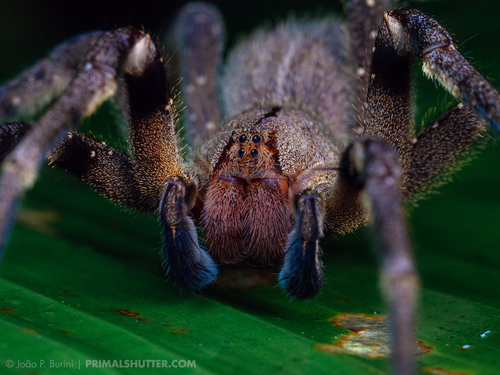
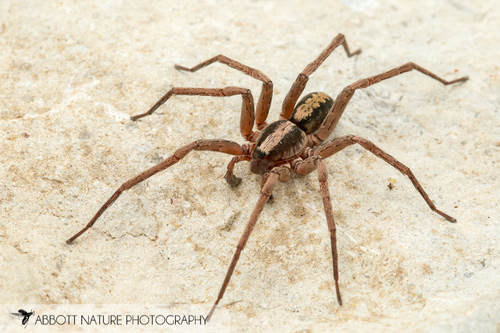
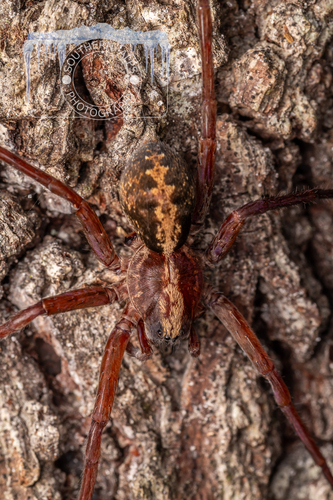
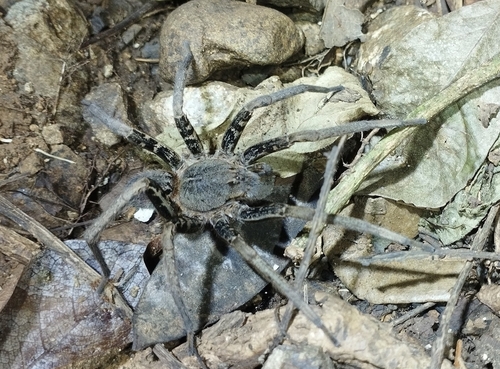
Ancylometes bogotensis (Keyserling, 1877) displays substantial size-related sexual dimorphism, with females being distinctly larger than males. Males have a total body length of roughly 21 mm, while females grow to approximately 26 mm. In males, the prosoma is brown with unique broad lateral white bands, the area around the eyes is bordered by white hairs, and the chelicerae also have white hairs near their base. The abdomen and legs of males are yellowish brown. The male pedipalp, its reproductive structure, has distinct traits: an embolus with a small knob that points toward a membranous lobe, and a characteristic hammer-shaped median apophysis. Females have a consistent light brown color across their whole body, with patchy brown markings on the femora. The female reproductive opening, the epigyne, has a narrow triangular median plate with a distinct, narrow but prominent central protuberance. Living specimens exhibit some variation in color: female prosomas are dark reddish brown, and their abdomens are generally light brown. The clypeus and chelicerae of females are covered in white hairs; the distal sections of the legs look whitish because of their hair covering, while the femora have spots of white hairs. Males are typically a somewhat lighter brown overall, and their prosoma has broad lateral yellow bands. This species has been recorded in Nicaragua, Honduras, Panama, Costa Rica, Venezuela, Trinidad, Guyana, Colombia, Ecuador, Bolivia, and Brazil. It has a broad distribution across the northern and western parts of South America, that extends north into Central America. Specimens collected from Recife, Brazil are thought to be likely introductions, not part of the species' natural native range. In the Manaus region of Brazil, A. bogotensis is especially abundant in floating meadows made up of Paspalum and other semi-aquatic and aquatic macrophytes that surround islands in whitewater rivers such as the Solimões River. The species also lives in both blackwater and whitewater inundation forests. These spiders are semi-aquatic, and have been observed hiding underwater for up to 20 minutes when disturbed. A. bogotensis is a semi-aquatic predator, and has been observed hunting frogs and tadpoles. When disturbed, it uses its notable aquatic adaptations to hide underwater for extended periods. Courtship, mating behavior, and the life cycle of this species have been studied in laboratory populations. Females produce large egg sacs that hold between 300 and 400 eggs, though some egg sacs can contain as many as 600 eggs. Egg parasitism is common, and studies have recorded up to 200 eggs in a single egg sac being parasitized.