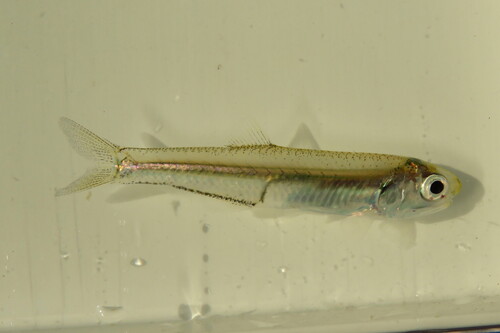
About Anchoa mitchilli (Valenciennes, 1848)
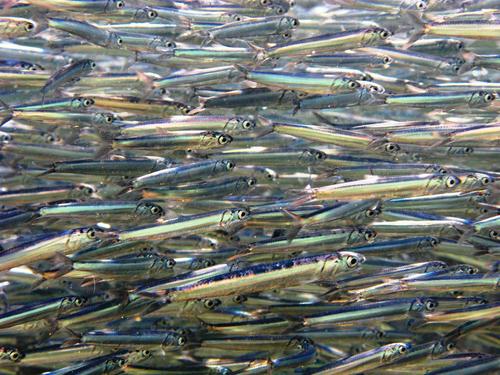
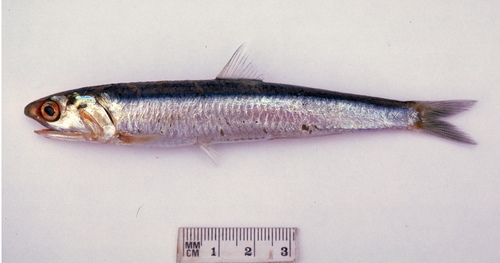
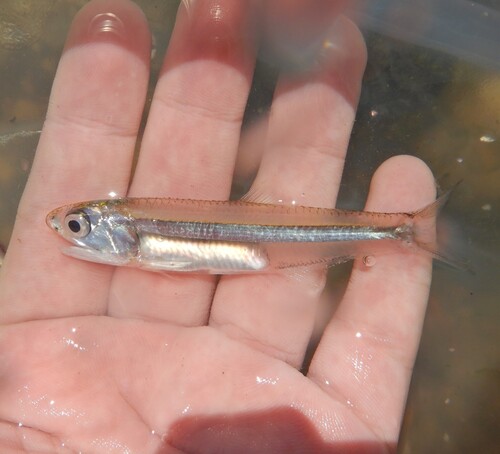
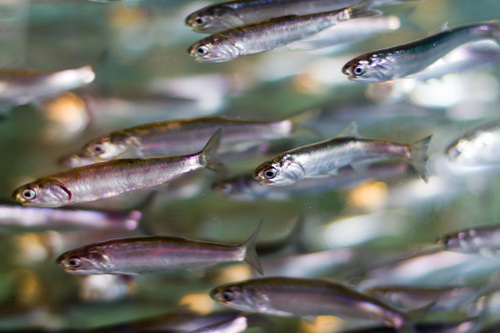
Anchoa mitchilli, commonly called the bay anchovy, is a small fish with somewhat variable appearance. It is a small, slender schooling fish with a greenish body and a silvery stripe. Key identifying features include a very long jaw, silvery belly, distinct lateral stripe, and single dorsal fin. The dorsal fin sits directly above the origin of the anal fin. Adult bay anchovy are generally around 6 centimetres (2.4 in) long, reaching a maximum length between 10 centimetres (3.9 in) and 11 centimetres (4.3 in). It has 14 to 16 dorsal fin rays, 24 to 30 anal fin rays, and 11 to 12 pectoral fin rays. This species can live more than three years. The bay anchovy resembles other Anchoa genus species that share its range: the similar-looking broad-striped anchovy grows larger, up to 15 centimetres (5.9 in), while the Cuban anchovy has its anal fin positioned further back on its body. This species ranges along the eastern coasts of North America from Maine to Yucatán, in the Atlantic Ocean and Gulf of Mexico. It is not found in the West Indies, and it is the most abundant fish in the well-studied Chesapeake Bay. It tolerates a wide range of water temperatures and salinities, including some hypersaline environments, but does not tolerate low-oxygen waters and easily asphyxiates when deprived of oxygen. The bay anchovy spends most of its time cruising through the water column, but can also be found over bare seabed substrates, in tide pools, in surf zones, and in muddy brackish waters. It rarely enters waters deeper than 25 metres (80 ft). Bay anchovy feed on zooplankton, including copepods, mysids, and crab larvae. In turn, they are an important prey source for many larger fish, such as weakfish (Cynoscion regalis), striped bass (Morone saxatilis), chain pickerel (Esox niger), and bluefish (Pomatomus saltatrix), as well as birds including royal terns (Thalasseus maximus) and Sandwich terns (T. sandvicensis). This species forms an important link in many ecosystem food webs, acting as a main pathway that converts zooplankton biomass into biomass for larger predatory fish. Bay anchovy reach sexual maturity when they grow to approximately 4 centimeters in length. They spawn in the water column, in both shallow and deeper waters. In the southern portion of their range, spawning occurs year-round, while populations further north breed only during warmer months. A single female can spawn 50 times in one breeding season, producing more than 1,000 eggs per spawn. Eggs hatch within 24 hours, and larvae mature in approximately 45 days. Growth rates for bay anchovy are variable and may depend on food availability. Humans use this species to make anchovy paste, as live or dead bait for fishing, as a harvested rough fish, and for production of fish oil and fish paste.