About Anchoa hepsetus (Linnaeus, 1758)
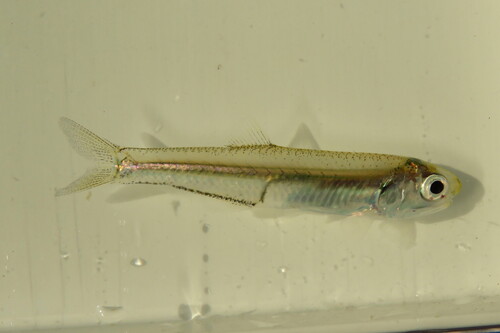
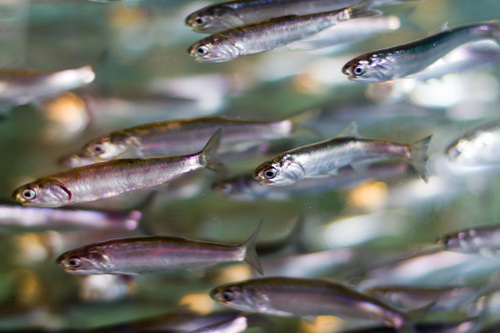
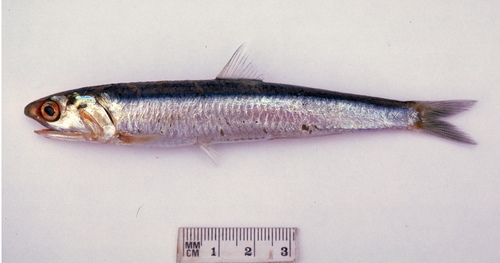
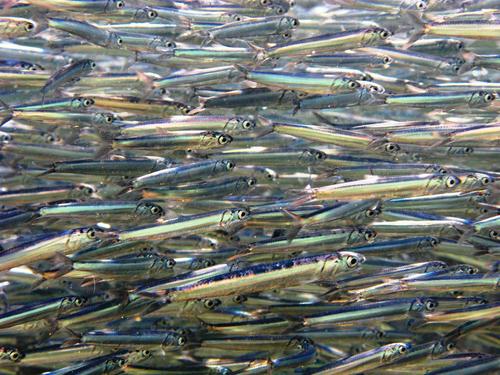
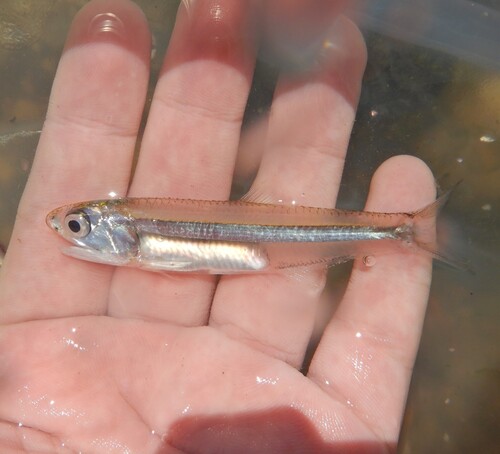
Anchoa hepsetus, commonly known as the broad-striped anchovy, is a ray-finned fish species belonging to the family Engraulidae. This species grows to a length of approximately 15 cm (6 inches). The broad-striped anchovy occurs in the western Atlantic along the North American coast: it is rarely found from Nova Scotia and the coast of Maine, and is abundant from Chesapeake Bay to the West Indies and Uruguay. It most often forms shoals in coastal waters, and can be found as deep as 73 m (40 fathoms), though it mostly inhabits water shallower than this depth. Broad-striped anchovies spawn in spring. Their eggs are pelagic, and hatch within 48 hours at typical spring water temperatures. Young anchovies eat copepods, while older individuals feed on other small crustaceans, molluscs, and worm larvae. This species is an important food source for large commercially harvested fishes, including the American seatrout, and is also commonly eaten by birds. It has an elongated body with large eyes, a protuberant snout, a large mouth, and an underslung jaw. Its anal fin is quite short, and its pectoral fin sits beneath the end of the dorsal fin. Its body is grey-green dotted with black, and its most distinct feature is a silvery stripe that runs all the way from its head to its tail.