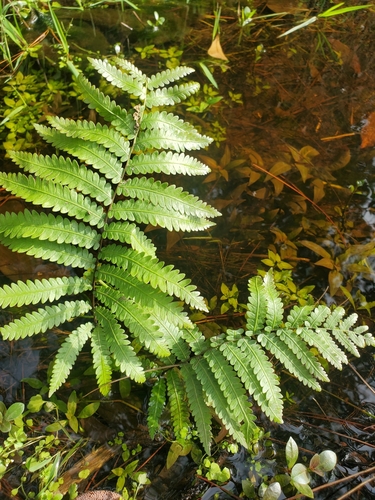
About Anchistea virginica (L.) C.Presl
Anchistea is a genus of leptosporangiate ferns in the family Blechnaceae. It contains only one species: Anchistea virginica, also known by the synonym Woodwardia virginica and the common name Virginia chain fern. This species has long creeping, scaly underground rhizomes that produce tall, widely separated, deciduous single fronds. Mature fronds can reach up to approximately 4 feet, or 120 centimetres, in height. Unlike A. virginica, the similar-looking Osmundastrum cinnamomeum grows in clustered fronds from a central crown. A. virginica also differs from O. cinnamomeum in having monomorphic leaves, with no distinct separate fertile fronds. The lower portion of the stipe, or leaf petiole, is dark purple to black, shiny and swollen, while the upper rachis is dull green. The leaf blade is green and lanceolate, made up of 12 to 23 paired, alternate pinnatifid pinnae. Each pinna is further divided into 15 to 20 paired segments that range from ovate to oblong in shape. The lower half of the rachis is bare, with no leaf tissue. Spore-producing bodies called sori form on the underside of the pinnae; these sori are long and arranged in a double row that outlines the major veins of the pinna. The spores themselves are produced in red-brown sori that line the areolae, the open spaces between the costa and costules of the pinna. Like all ferns, A. virginica goes through alternation of generations in its life cycle, including a gametophyte stage that develops into a haploid, independent reproductive prothallus plant. Additional photographs of this species are available on the Connecticut Botanical Society and Ontario Ferns websites. Anchistea virginica is endemic to eastern North America. Its range extends from Florida north to Nova Scotia, and west to Michigan and Illinois. It occurs most commonly on the Atlantic coastal plain and Piedmont, but also grows in the eastern Great Lakes region as far west as Illinois. A distribution map for this species can be found on the Flora of North America website. Anchistea virginica grows in wet soils, in locations including open wet swampy woods, acid bogs, streamsides, and roadside ditches. It does not grow on calcareous substrates. It is an important component of the field layer in flatwoods, Atlantic white cedar (Chamaecyparis thyoides) swamp forests, and sweet bay (Magnolia virginiana) forests. This species is occasionally cultivated as an ornamental plant for greenhouses or gardens. It is hardy to USDA Zone 3.