About Anaxyrus speciosus (Girard, 1854)
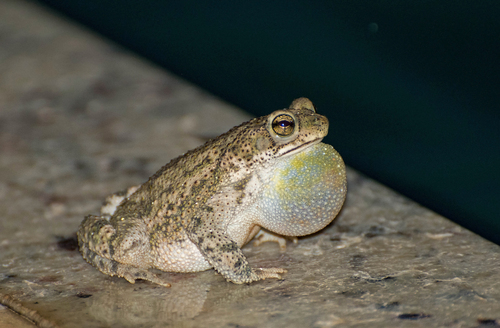
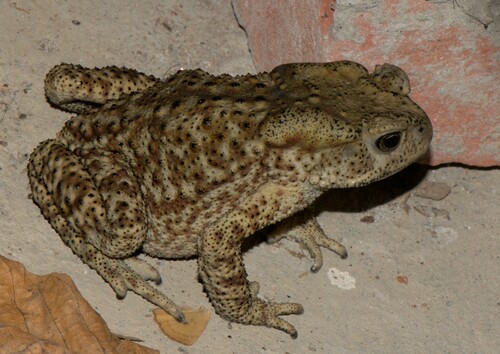
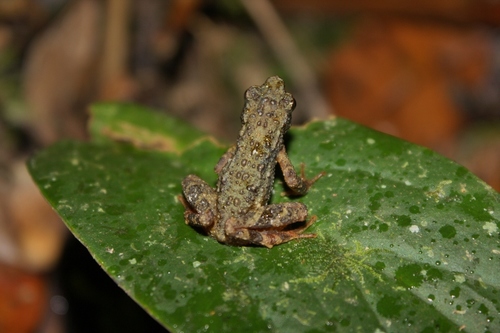
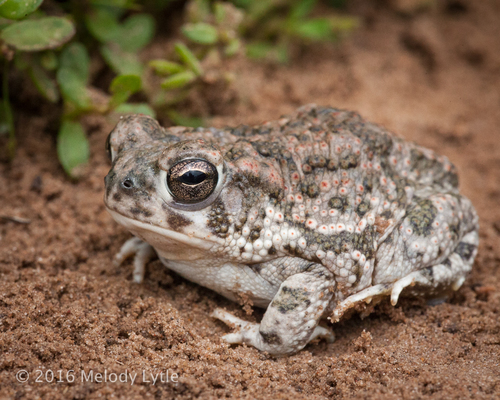
Anaxyrus speciosus, commonly called the Texas toad, has an average snout–vent length of 52–78 mm (2.0–3.1 in) for males and 54–91 mm (2.1–3.6 in) for females. It is native to the United States, where it occurs primarily in Texas; in 2009, it was designated the official Texas State Amphibian. Its range also extends north into Oklahoma, west into New Mexico, and south into northern Mexico. This is a desert-dwelling species that inhabits dry grassland, savannas with scattered mesquite, and open woodland, and is most often found on sandy or frequently inundated soils. The Texas toad feeds on insects including beetles, ants, and bugs. It digs its own burrow in soft soil, and can bury itself in mud. It will sometimes hide in gopher burrows, under logs, or in deep cracks in mud to avoid desiccation, and remains dormant for most of the time during extended dry periods. Breeding takes place after heavy rains. Males gather at temporary pools, ditches, cattle tanks, and other wet sites, and call continuously, most often at night. Their call is described as a series of explosive trills: each trill lasts around one and a half seconds, with one-second gaps between trills. Females appear to be most attracted to the largest males that produce the loudest calls. Eggs are laid in water, and often become entangled in submerged vegetation. The eggs hatch within two days, and the resulting tadpoles feed on algae that grows on underwater plants. When disturbed, tadpoles will retreat to deeper water. Tadpoles stay in this life stage between 18 and 60 days, with the exact length depending on conditions like water temperature. After this period, they complete metamorphosis and leave the water as juvenile toads. Other species of toad that use the same water bodies for breeding include the Gulf Coast toad (Incilius nebulifer), the green toad (Anaxyrus debilis), the Great Plains narrow-mouthed toad (Gastrophryne olivacea) and Couch's spadefoot toad (Scaphiopus couchii). The Texas toad sometimes hybridizes with Woodhouse's toad (Anaxyrus woodhousii) or the Great Plains toad (Anaxyrus cognatus).