About Anaxyrus quercicus (Holbrook, 1840)
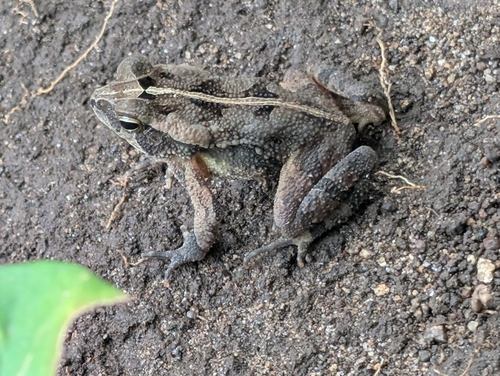
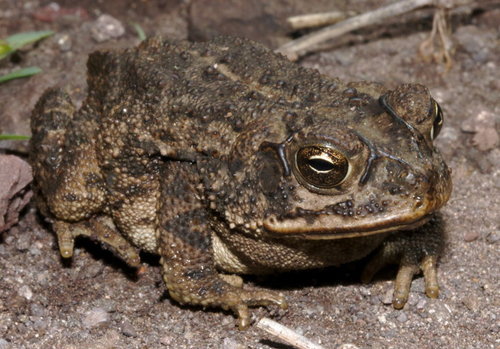
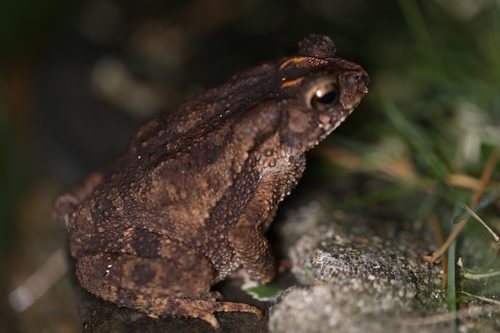
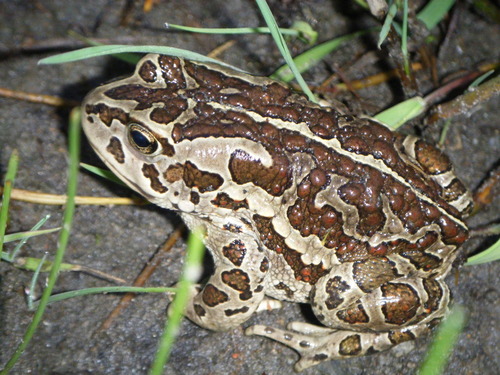
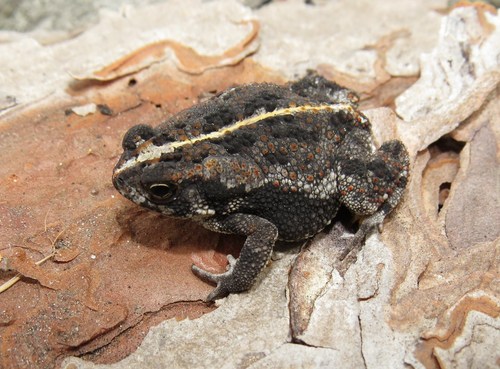
Anaxyrus quercicus, commonly called the oak toad, can be identified by a light mid-dorsal stripe, variable brown and black spots, and proportionally large parotoid glands. One of its most notable traits is the small size of adult individuals compared to other toad species. Males can be told apart from females by their solid white belly and a slightly distended, loose flap of skin under the mouth that expands to form the vocal sac. Females have a dark-spotted belly and no vocal sac.
The oak toad is native to coastal regions of the southeastern United States, with a range extending from eastern Louisiana to southeast Virginia, and south across all of Florida. It occupies a variety of habitat types, including sandy pine flatwoods, oak scrub, open pine and pine-oak woods, pine or oak savanna with sandy soils, and maritime forests. Oak toads prefer open-canopied pine flatwoods with grassy ground cover, and are generally found in moist, grassy areas near sandy-soil pine or oak savannas. They also occur in vernal pools and freshwater wetlands.
For its life cycle, oak toad eggs develop very quickly, hatching in just 24 to 36 hours. Fully grown tadpoles reach a maximum length of 18 to 19.4 mm (0.71 to 0.76 inches). Tadpoles are grayish olive or grape-green on their dorsal side, and purplish on their ventral side. The tail has 6 or 7 black saddle-shaped markings. Tadpoles complete metamorphosis into juvenile toadlets after 4 to 6 weeks, and reach adulthood and sexual maturity between 1.5 and 2.3 years of age. The overall lifespan of the species is not confirmed. There are records of oak toads living for four years in captivity, and the reported average captive lifespan is 1.9 years.