About Anaxyrus hemiophrys (Cope, 1886)
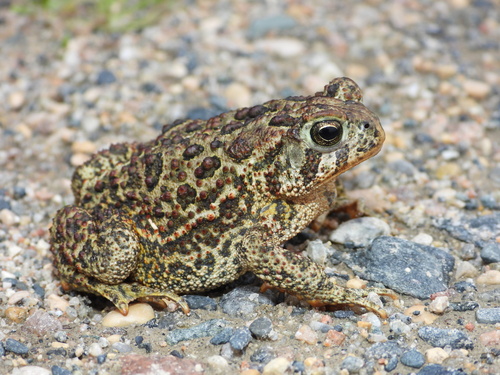
The Canadian toad (Anaxyrus hemiophrys) grows to around 7.6 cm (3 in) in total length. Fully grown adult males usually measure 5.6 to 6.9 cm (2.2–2.7 in) long, while adult females are slightly larger, ranging from 5.6 to 7.9 cm (2.2–3.1 in) in length. Adults weigh between 35 and 55 g. In his 1886 description, Cope described the species' colouration as brown, with a median yellowish stripe on the back, and two to three rows of medium-sized brown spots on each side of this stripe. Each spot holds one to two tubercles at its center, which are redder than the rest of the spot. Cope also noted two spots on the upper lip, one spot below the tympanum, and a large spot that extends from below the parotid gland to near the front of the humerus. The parotid gland is narrow and produces a toxin that defends the toad from predators. This toxin causes irritation to the eyes and mouth, and causes illness if ingested; despite the toxin, the toad is safe to handle. The coronal crests of Anaxyrus hemiophrys are well defined. The interorbital crests are narrow, relatively sharp-edged, non-porous, and widely separated. They run relatively parallel for most of their length, extending posteriorly to the level of the coronal crests. Posterior to this level, they flare outward laterally to join the postorbital crests, marking the anterolateral edge of the postcoronal plane. The postcoronal plane is clearly defined, slopes posteroventrally, is smooth and subtriangular, with its apex pointing toward the posterior and ending at the foramen magnum. Its sides are marked anteriorly by short parietal crests. The shape of the interorbital crests is particularly useful for external identification of this species. In Anaxyrus hemiophrys, the posterior ends of the crests almost always diverge at least slightly where they connect to the postorbital crests, a feature that is usually not visible externally. This trait is the easiest way to distinguish Anaxyrus hemiophrys from its close relative Anaxyrus americanus, which shares part of its range. While some sources note a difference in crest structure: in some descriptions of Anaxyrus hemiophrys, postorbital crests are absent and the interorbital crests are fused to form a boss between the eyes, whereas in Anaxyrus americanus, the interorbital crests are well separated and connect to distinct postorbital crests at a right angle. The boss is a soft tissue structure characteristic of this genus, anchored by the skull structures described above. On the back of the external surface of the tibia, there are several rows of dermal tubercles. When the hind leg is extended, the heel of the hind foot reaches the level of the posterior edge of the orbit. The metatarsal tubercles are large. The internal metatarsal tubercle is very wide and prominent, with an extensive sharp edge, while the external tubercle is smaller, with a free cutting edge that lies transverse to the length of the tarsus. Breeding for Anaxyrus hemiophrys typically begins when individuals first emerge in late April to early May, and continues until August or September. Breeding occurs in aquatic habitats. During mating, the male grasps the female in a behavior called amplexus. The female deposits eggs in shallow water, and the male fertilizes the eggs with his sperm as they are laid. Females lay eggs in the shallow areas of lakes, ponds, and other similar standing water bodies. These waters contain vascular plant debris, new grass shoots, and/or sparse cattail. This habitat gives the eggs shelter, helps prevent them from being washed away by water flow, and provides nutrients for tadpoles after hatching. Anaxyrus hemiophrys lays eggs in strings, and can lay up to 20,000 eggs per year, with typical clutches holding around 6,000 eggs. The eggs hatch after four to five days. Tadpoles remain in the water where they hatched for 7 to 11 weeks, during which time they undergo metamorphosis into juvenile toads. Tadpoles are suspension feeders, consuming plant nutrients present in the water. Juveniles stay close to the water and are typically found in large numbers near breeding sites. Adult Anaxyrus hemiophrys live near lakes, streams, irrigation ditches, and wetlands. Males reach sexual maturity at around one year old, while females reach maturity at around two years old. Individuals live between seven and twelve years, with the oldest recorded individuals found in the middle of the sampled latitudinal range.