About Anaxyrus boreas (Baird & Girard, 1852)
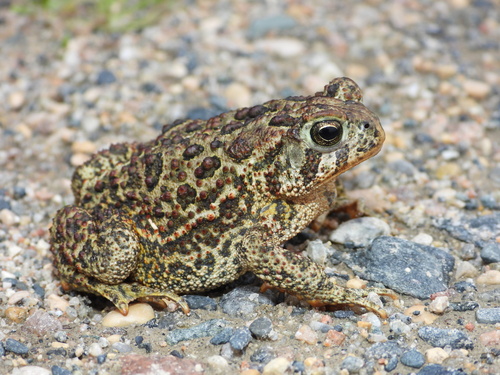
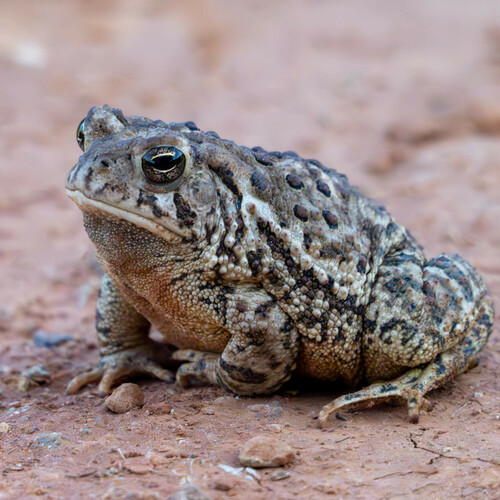
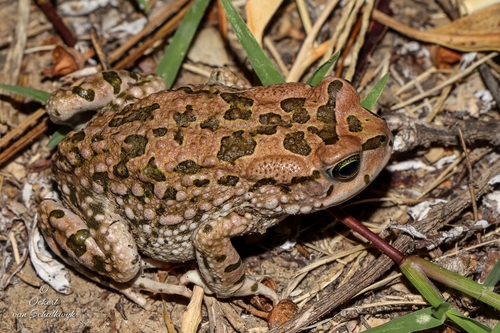
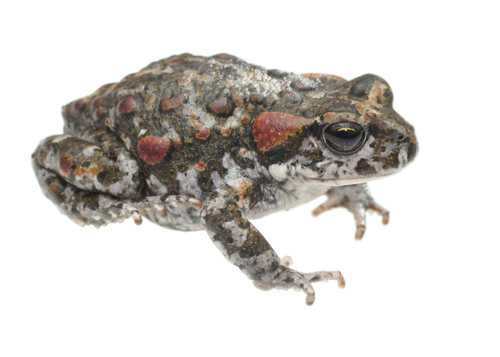
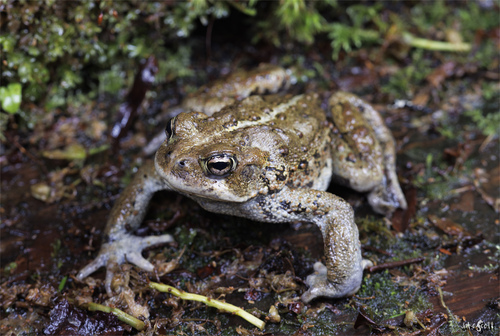
Anaxyrus boreas (Baird & Girard, 1852), also referred to as the western toad or boreal toad, can be described by the following characteristics: Most adults have a white or cream dorsal stripe, with dusky gray or greenish dorsal skin that has skin glands concentrated inside dark blotches. Its parotoid glands are oval, widely separated, and larger than the upper eyelids. It has a mottled belly, horizontal pupils, and does not have cranial crests. Compared to females, males have smoother skin, less obvious dorsal blotching, and develop nuptial pads (thickened skin) on their forefeet during the breeding season. For juvenile individuals of this species, the dorsal stripe is weak or entirely absent. Larger young individuals have prominent dorsal and ventral spotting, and yellow feet.
Distribution: The range of this toad extends from western British Columbia and southern Alaska, south through Washington, Oregon, and Idaho to northern Baja California, Mexico; east to Montana, western and central Wyoming, Nevada, the mountains and higher plateaus of Utah, and western Colorado. Occurrences in Yukon Territory, the Northwest Territories, and northwestern and north-central British Columbia have been reported. There are published southern records of boreal toads in New Mexico, but the species is considered extirpated from the state, and a reintroduction project is currently in progress there.
Habitat: The boreal toad is found in aspen (Populus spp.) groves and riparian forests in the Rocky Mountains. In Colorado, the largest populations are typically found in areas dominated by willows (Salix spp.), bog birch (Betula glandulosa), and shrubby cinquefoil (Potentilla fruticosa). In the Pacific Northwest, the western toad lives in mountain meadows, and less commonly occurs in Douglas-fir forests (Pseudotsuga menziesii). In California, optimum habitat for the western toad is wet or dry mountain meadows or riparian deciduous forest with accessible open water for breeding. Suitable habitat includes blue oak (Quercus douglasii) savanna, gray pine-oak forest (Pinus sabiniana-Quercus spp.), mixed conifer forest, and alpine meadows. Marginal habitats include annual grasslands, chaparral, ponderosa pine forests, California black oak woodlands, Jeffrey pine forests, and red fir forests. In the Sierra Nevada, the western toad lives in mid-elevation pine forests (including Jeffrey pine (Pinus jeffreyi) at higher elevations and ponderosa pine (Pinus ponderosa) at lower elevations), California black oak woodlands (Quercus kelloggii), giant sequoia groves (Sequoiadendron giganteum), montane fir forest (which includes white fir (Abies concolor), red fir (Abies magnifica), and western white pine (Pinus monticola), and redwood forest (Sequoia sempervirens). It is also found in riparian areas within sagebrush-pinyon communities (Artemisia spp.-Pinus spp.), oak-pine woodland and savanna (including coast live oak (Quercus agrifolia), interior live oak (Quercus wislizenii), and canyon live oak (Quercus chrysolepis), and California coastal forest and scrub. Western toads have been collected from sedge meadows near a pond located within a creosotebush (Larrea tridentata) community, and from aspen (Populus spp.)-willow groves within big sagebrush (Artemisia tridentata)-grassland.
Preferred habitat: Western toads are widespread across the mountainous areas of northwestern North America, ranging from sea level to elevations near or above regional treeline, reaching up to 10,000 feet (305–3,050 m) in elevation. It is uncommon at the highest elevations. In Colorado, the elevational range is from about 7,000 to 11,860 feet (2,130 to 3,610 m). In the mountains of Colorado, the largest western toad populations are usually found between approximately 9,500 to 11,000 feet (2,900 to 3,400 m) elevation. Western toads live in desert streams and springs, grasslands, and mountain meadows; they are less common in heavily wooded regions. They are usually found in or near ponds, lakes (including saline lakes), reservoirs, rivers, and streams within the habitats listed above. Under laboratory conditions, western toads were able to survive in 40% seawater, but died within a week when exposed to 50% seawater. In Colorado, individual western toads typically maintain distinct home ranges that vary greatly in size based on habitat condition. Breeding males may show territorial behavior, especially in areas where breeding sites are scarce. Western toad populations have very limited dispersal, particularly in rugged terrain.
Western toads require open water for breeding. All breeding individuals in a local population tend to lay their eggs in the same location, which is reused year after year. For example, at a site on a permanent lake in the Oregon Cascade Range, western toads returned each year to the same submerged willow clumps. Eggs are usually laid in shallow water, no deeper than 12 inches (300 mm) and usually at least 6 inches (150 mm). The warmth of shallow water speeds up egg development, and shallow water with vegetation can also help protect eggs from predation by fish. In western Montana, breeding western toads used gravel pits that only filled with water during spring runoff. These gravel pits had cattails (Typha spp.) but no other vegetation, and were 5 feet (1.5 m) deep in the center.
Life cycle: Western toads are active from January to October, depending on latitude and elevation, and hibernate through the winter. Boreal toads from one Colorado population used natural chambers near a small stream bed. The high water table, constantly flowing stream, and deep winter snow kept the air temperature in the hibernaculum slightly above freezing. They emerged from hibernation after a few days of warm temperatures freed the entrance and raised the temperature inside the chamber to about 39.2 °F (4.0 °C). At low elevations western toads are active at night; at high elevations and in the northern parts of their range they are active during the day. The body temperature of western toads is closely correlated with substrate temperature. Basking and heat conduction from the substrate are the main ways they increase body temperature, and cooling is done through evaporative cooling and heat conduction to cooler material. Diurnal and nocturnal activity is often linked to seasonal temperature changes; most western toads are diurnal in spring and fall but nocturnal during the warmer summer months. In central Oregon, the minimum breeding age for male western toads is three years, and is probably four or five years for females. California populations of this toad are reported to reach sexual maturity at 2 years of age. Male western toads breed every year; females breed at less regular intervals, depending on their individual condition and breeding effort in previous years. Sex ratios differ by habitat type; males are more numerous in wet areas and females are more numerous in dry habitats. Eggs are laid in open water from February to July, with peak breeding activity in April. The timing of egg-laying changes with elevation and weather conditions. In Colorado, the start of breeding was correlated with the arrival of warming weather and the start of snowpack melting. Eggs are usually laid in late May or early June. In western Montana in 1967, a few males were present on the shores of two gravel pits by May 11, and by May 14 each pond had at least 30 males. Males were spaced at least 1 foot (0.30 m) apart, all facing the shore. Eggs are laid in gelatinous strings holding 13 to 52 eggs per inch (2.5 cm), in total masses of up to 16,500 eggs per clutch. Egg development rate is partially dependent on temperature, so hatching times vary. Metamorphosis is usually completed within three months of egg laying. The time required for metamorphosis is recorded as 30 to 45 days for the boreal toad and 28 to 45 days for the California population of this toad. Female western toads at least 10 to 11 years of age have been reported. In Colorado, boreal toads likely reach a maximum age of at least 9 years.
Food habits: Western toads wait for prey on the ground surface or in shallow burrows dug by other animals. Their diet is largely made up of bees, beetles, ants, and arachnids. Other food items include crayfish, sow bugs, grasshoppers, trichopterans, lepidopterans, and dipterans.