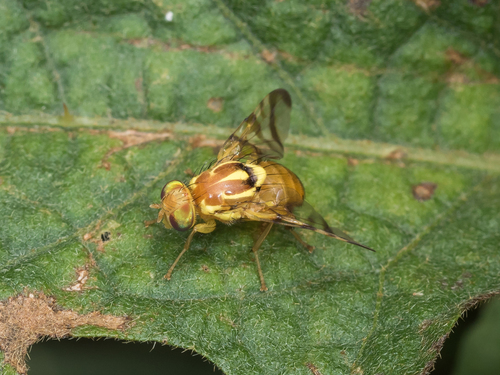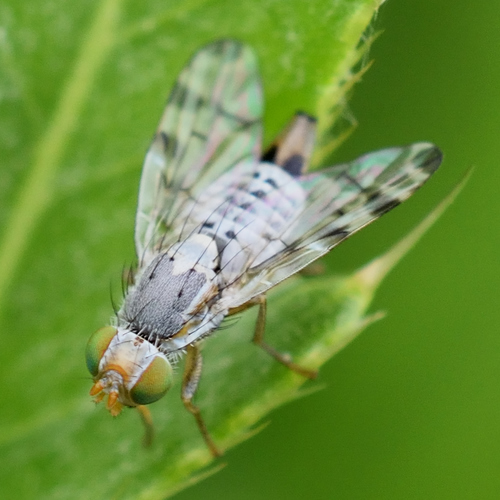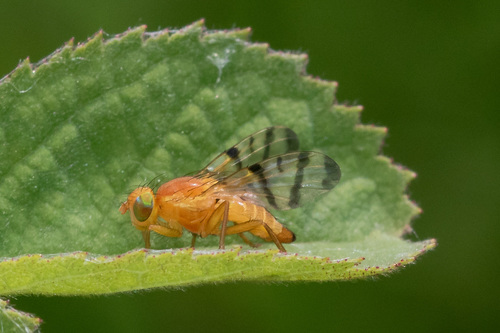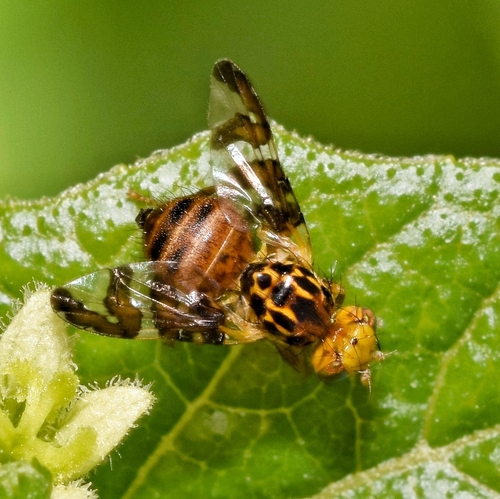
About Anastrepha ludens (Loew, 1873)
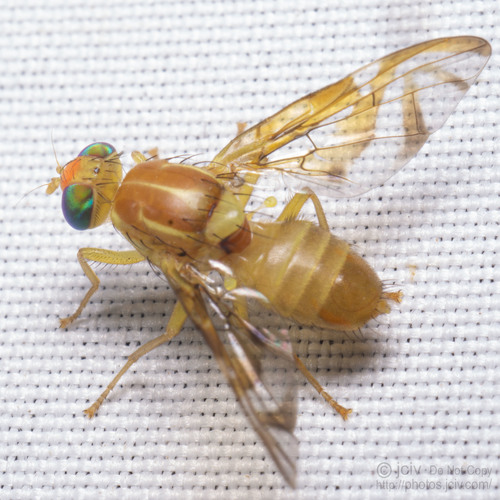
Anastrepha ludens, commonly called the Mexican fruit fly or Mexfly, is a species of fly in the Anastrepha genus, part of the Tephritidae fruit fly family. It is closely related to the Caribbean fruit fly Anastrepha suspensa and the papaya fruit fly Anastrepha curvicauda. This species is native to Mexico and Central America, and is a major pest of citrus and mango agriculture in Mexico, Central America, and the lower Rio Grande Valley. Compared to other fruit fly species, Mexican fruit flies have high fecundity and relatively long lifespans. These traits make it a particularly aggressive invasive species; it is especially threatening to agriculture because its larvae develop and feed on a wide range of different fruit species. The Anastrepha genus is classified as one of three genera that pose the greatest risk to United States agriculture. The USDA notes that A. ludens is the only significant member of the Anastrepha genus that is subtropical rather than tropical, so its range extends much further north than most other Anastrepha species. The USDA also estimates that Mexfly causes $1.44 billion in damage over a 5-year period, mostly to citrus farms. It is regularly categorized as an invasive species in Southern California and Arizona, and poses a serious threat to grapefruit agriculture in Florida. As for distribution, Anastrepha ludens is native to Guatemala, Mexico, and may be native to Costa Rica; it is an invasive species in the United States. The first recorded sighting of these flies outside their native range of Mexico and Central America was a small colony in Texas in 1903. By 1927, Mexican fruit flies were infesting citrus farms in the lower Rio Grande Valley of Southern Texas, and threatening farmland in California, Texas, Florida, and Arizona. By 1954, the species had spread west as far as Hermosillo. The flies were rare in Costa Rica until the 1990s, when they suddenly appeared on citrus plants; it is uncertain whether the species is native to Costa Rica or migrated there from the north. Previously, the species was incorrectly thought to be native to Colombia due to misidentification of Anastrepha manizaliensis, and it is now confirmed that A. ludens does not occur there. The United States Department of Agriculture assumes that flies entered the US via imports of fruit infested with larvae. Currently, California, Arizona, Florida, and most of northern Mexico are considered free of Mexican fruit flies. Eradication efforts are ongoing in Texas, and some quarantine areas in Texas have been successfully cleared, with quarantines lifted. The eradication of this fly from most of the US and northern Mexico is largely the result of successful implementation of the sterile insect technique, also called SIT. SIT is currently used in parts of Texas to control the species' population. Mexican fruit flies prefer to live near citrus and other fruit species, which act as hosts where females can lay their eggs. Anastrepha suspensa feeds on many of the same fruits in the same regions that A. ludens primarily inhabits. A. ludens prefers to lay eggs in grapefruits and oranges, but has been recorded using many other host plants: Anacardium occidentale (cashew), Annona cherimola (cherimoya), Annona reticulata (custard apple), Annona squamosa (sugar-apple), Carica papaya (papaya), Casimiroa edulis (white sapote), Casimiroa tetrameria (matasano), Citrus aurantiifolia (lime), Citrus maxima (pummelo), Citrus aurantium (sour orange), Citrus limetta (sweet lime), Citrus x paradisi (grapefruit), Citrus medica (citron), Citrus reticulata (tangerine), Citrus sinensis (sweet orange), Coffea arabica (arabica coffee), Cydonia oblonga (quince), Diospyros kaki (Japanese persimmon), Feijoa sellowiana (feijoa), Inga (shimbillo), Malus domestica (apple), Malus pumila (paradise apple), Mammea americana (mammey apple), Mangifera indica (mango), Sideroxylon capiri (bully tree), Passiflora edulis (purple granadilla), Persea americana (avocado), Pouteria sapota (sapote), Prunus persica (peach), Psidium guajava (common guava), Psidium littorale (strawberry guava), Punica granatum (pomegranate), Pyrus communis (pear), Sargentia greggii (yellow chapote), Spondias purpurea (red mombin), and Syzygium jambos (rose-apple). Experiments have confirmed that A. ludens prefers oranges and grapefruit over other hosts, but will lay larvae on any of the listed hosts when these preferred fruits are not available.