About Anastomus oscitans (Boddaert, 1783)
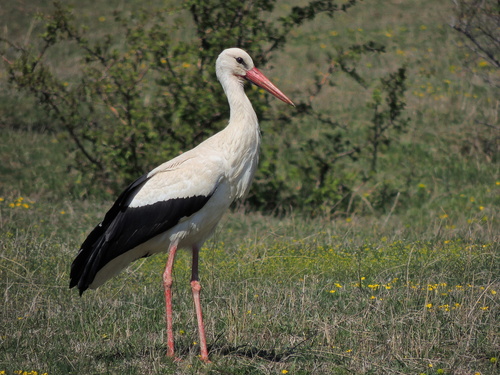
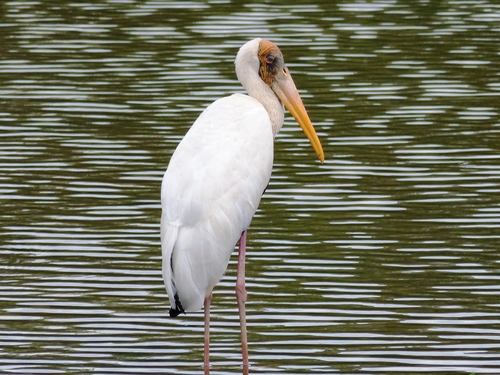
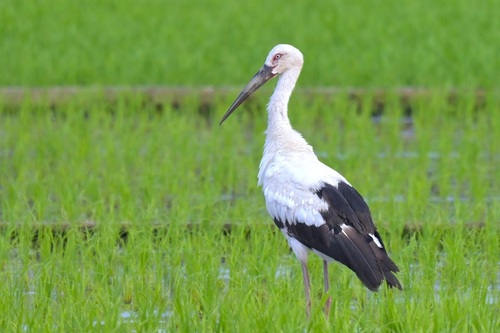
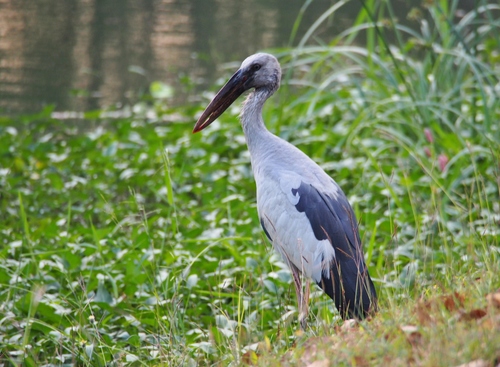
Anastomus oscitans, the Asian openbill stork, shows distinct seasonal plumage variation: it is predominantly greyish in the non-breeding season and white in the breeding season, and always has glossy black wings and tail with a green or purple sheen. The species gets its name from the distinctive gap between the recurved lower mandible and arched upper mandible of the beak that forms in adult birds; young birds do not have this gap. The cutting edges of the mandibles have a fine brush-like structure thought to improve grip on snail shells. This species has 12 tail feathers, its preen gland has a tuft, the mantle is black, and the bill is horn-grey. From a distance, Asian openbill storks can resemble white storks or Oriental storks. Their short legs are pinkish to grey, and turn reddish before breeding. Non-breeding individuals have smoky grey wings and back instead of white, while young birds are brownish-grey with a brownish mantle. Like other storks, the Asian openbill is a broad-winged soaring bird that relies on moving between hot air thermals for sustained flight, flies with its neck outstretched, is typically found in flocks though single birds are not uncommon, and is relatively small for a stork, standing 68 cm tall and measuring 81 cm long. Asian openbill storks most often forage in inland wetlands, and are only rarely seen along river banks and tidal flats. In agricultural landscapes, they forage in crop fields, irrigation canals, and seasonal marshes. Birds may move over large areas in response to changing habitat conditions, and young birds disperse widely after fledging. Individuals ringed at Bharatpur in India have been recovered 800 km east, and a bird ringed in Thailand has been recovered 1500 km west in Bangladesh. Between August and September on overcast nights, storks are regularly disoriented by lighthouses along the southeast coast of India. The species is very rare in the Sind and Punjab regions of Pakistan, but widespread and common in India, Sri Lanka, Nepal, Bangladesh, Myanmar, Thailand and Cambodia, and has recently expanded its range into southwestern China. At Thirunavaya Lotus Lake Wetland in Malappuram district, Kerala, India, they are mostly seen between September and February. Asian openbills appear to be particularly susceptible to dying during hailstorms: 45 individuals were found dead after a hailstorm in Xishuangbanna, south China, where no carcasses of other bird species were observed. During the warmer part of the day, Asian openbills soar on thermals and habitually descend rapidly into their feeding areas. Groups may forage together in close proximity in shallow water or marshy ground, walking with a slow, steady gait. The Asian openbill feeds mainly on large molluscs, especially Pila species. It separates the snail's body from its shell using the tip of the beak; the tip of the lower mandible is often twisted to the right, inserted into the snail's opening, and the body is extracted with the bill still under water. Jerdon observed that these storks can capture snails even when blindfolded. Because the exact feeding method was hard to observe, it led to considerable early speculation. Sir Julian Huxley examined evidence from specimens and literature, concluding that the bill gap was used like a nutcracker, and that the rough edges of the bill formed from wear caused by this behavior. Subsequent studies have rejected this idea, and instead suggest the rough edge of the bill is an adaptation to help handle hard, slippery snail shells. Asian openbills forage for prey by holding their bill tips slightly apart and making rapid vertical jabs in shallow water, often with the head and neck partially submerged. The bill gap does not play a role in handling snail shells, and only develops with age; young birds without a gap are still able to forage successfully on snails. It has been suggested that the gap allows the bill tips to strike at a greater angle, increasing the force the tips can apply to snail shells. Smaller snails are most often swallowed whole or crushed. At one site in Thailand, Asian openbills feeding on Pomacea canaliculata were observed to discard the males' testes and females' albumen glands. They also feed on water snakes, frogs and large insects. When foraging in agricultural landscapes with multiple habitat types, Asian openbills prefer to use natural marshes and lakes, especially during the monsoon and winter, and irrigation canals, especially during the summer.