About Anastomus lamelligerus Temminck, 1823
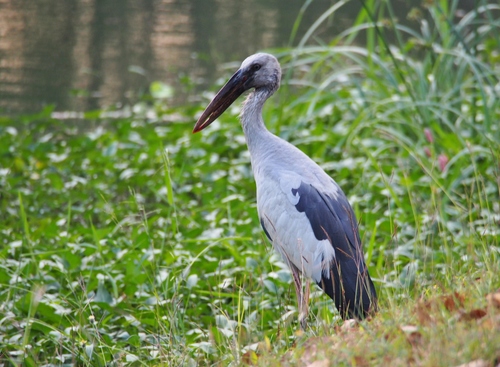
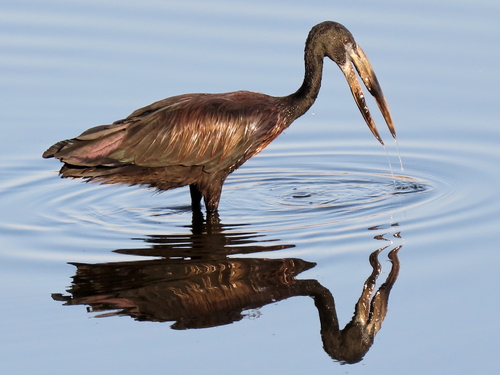
The African openbill, Anastomus lamelligerus Temminck, 1823, is a species of stork that measures 80–94 cm (31–37 in) in length and weighs 1–1.3 kg (2.2–2.9 lb). This species does not show major sexual dimorphism, though males are slightly larger than females, and have longer, heavier bills. An adult's bill is between 135–196 mm (5.3–7.7 in) long, brownish in color, and has a gap between the upper and lower mandible. This gap is not present in juvenile birds, and develops as the bird ages. The genus "openbill" gets its name from the fact that the two mandibles of the beak only meet at the tip, not in the middle. Adult plumage is overall black, with iridescent green feathers on the back, wing coverts, and abdomen. Juvenile plumage is typically less vibrant, browner in color, and the underpart feathers have pale tips. The legs and feet are black. The eyes are grey, with grey lores, and no distinct colored eye-ring. African openbill storks occupy any habitat that has access to suitable mollusc prey. Their preferred habitats are long stretches of freshwater. They may sometimes be seen far from humid habitats, but this only occurs exceptionally. They are most frequently found on large freshwater wetlands with nearby tall trees or shrubs available for nesting. In Kenya, African openbill storks are deliberately poisoned by poachers. Poisoning occurs through a specialized baiting technique that uses a live decoy. Poachers set out the decoy then disturb stork flocks, forcing the birds to settle near the decoy. African openbills then feed on poisoned snails located near the decoy. This method disproportionately impacts the African openbill stork because the species is flocking, and lives year-round in the areas poachers poison. They are also targeted preferentially because poachers earn greater profit from these birds. While the species is not currently at risk, the continuation of this poaching method could be harmful to African openbill populations. This poisoning practice persists in Kenya due to the social importance of eating wild bird meat. It has become a widespread habit among the local population, who believe wild meat is the best available option, especially when it is low-cost.