About Anas undulata C.F.Dubois, 1838
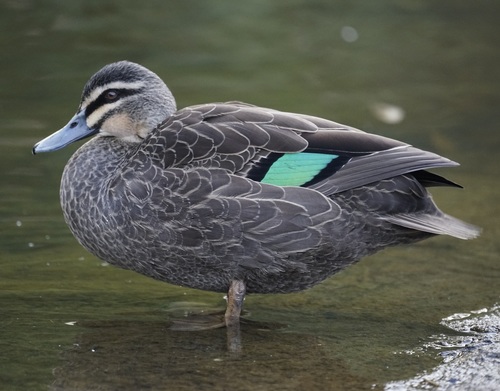
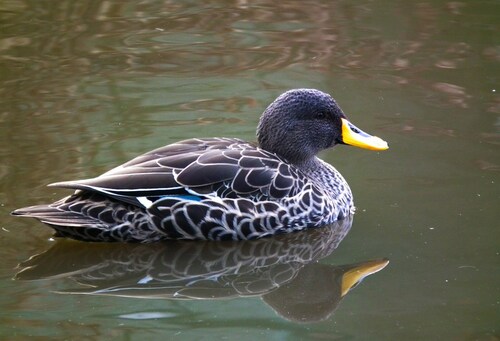
This species, commonly called the yellow-billed duck, is mallard-sized, mostly grey, with a darker head and a bright yellow bill. The undersides of its wings are whitish, and the upper surface of the wings features a green speculum bordered with white. Males and females have similar plumage, while juvenile individuals are slightly duller in color than adults. The north-eastern subspecies is darker overall, has a brighter bill, and possesses a blue speculum instead of green. The yellow-billed duck occupies freshwater habitats in fairly open terrain. It feeds by dabbling for plant matter, and does most of its feeding during the evening or at night. It builds its nests on the ground, in dense vegetation located close to water. Rarely, this duck can be found in suburban areas near golf courses, parks, and lakes or dams. A typical clutch contains between six and twelve eggs. Males produce a teal-like whistle, while females produce a mallard-like quack. There are two recognized subspecies of the yellow-billed duck: A. undulata rueppelli, the northern yellow-billed duck, and A. undulata undulata, the southern yellow-billed duck. The yellow-billed duck is one of the species covered by the Agreement on the Conservation of African-Eurasian Migratory Waterbirds, or AEWA. The southern nominate subspecies is currently declining, a trend caused by competition and hybridization with feral mallards, as noted in Rhymer 2006.