About Anas platyrhynchos Linnaeus, 1758
The mallard (Anas platyrhynchos Linnaeus, 1758) is a medium-sized waterfowl species, often slightly heavier than most other dabbling ducks. Adults measure 50–65 cm (20–26 in) in total length, with the body making up around two-thirds of this length; they have a wingspan of 81–98 cm (32–39 in), and weigh 0.7–1.6 kg (1.5–3.5 lb). Standard measurements are: wing chord 25.7 to 30.6 cm (10.1 to 12.0 in), bill 4.4 to 6.1 cm (1.7 to 2.4 in), and tarsus 4.1 to 4.8 cm (1.6 to 1.9 in).
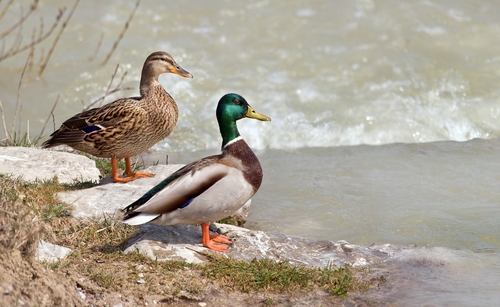
Breeding male mallards have easily identifiable plumage: a glossy bottle-green head, a white collar separating the head and neck from a purple-tinged brown breast, grey-brown wings, a pale grey belly, and a black rear with dark tail feathers bordered in white. The male’s bill is yellowish-orange with a black tip. Female mallards generally have darker bills that range from black to mottled orange and brown. Females are predominantly mottled, with each individual feather showing sharp contrast from buff to very dark brown, a color pattern shared by most female dabbling ducks. They have buff cheeks, eyebrow, throat, and neck, paired with a darker crown and eye-stripe.
Like other sexually dimorphic birds, mallards can occasionally experience spontaneous sex reversal, most often caused by damaged or nonfunctioning sex organs (such as the ovaries in female mallards). This can lead to females developing male plumage, and males developing female plumage, known as phenotypic feminization or masculinization.
Both sexes have distinct iridescent purple-blue speculum feathers edged with white, which are noticeable both in flight and at rest, but are temporarily shed during the annual summer moult. Newly hatched mallard ducklings have yellow plumage on the underside and face (with streaks by the eyes), and black plumage on the back extending to the top and back of the head, with small yellow spots. Their legs and bill are also black at hatching. When ducklings are close to one month old, their plumage becomes drab and resembles that of adult females, though it is more heavily streaked, and their legs lose their dark grey colouring. The fledgling period ends two months after hatching, at which point the duckling becomes a juvenile, and can fly 50–60 days after hatching. The bill soon loses its dark grey colouring, and sex can finally be distinguished visually by three traits: 1) males have yellow bills, while females have black and orange bills; 2) males have reddish-brown breast feathers, while females have brown breast feathers; and 3) the centre tail feather (called the drake feather) is curled in males, but straight in females.
During the final maturation stage leading to adulthood (between 6 and 10 months of age), female juvenile plumage stays unchanged, while male juvenile plumage gradually shifts to the characteristic adult male coloration. This seasonal plumage change also occurs in adult male mallards when they transition into and out of their non-breeding eclipse plumage at the start and end of the summer moulting period. Mallards reach adulthood at fourteen months of age, have an average life expectancy of three years, and can live up to twenty years.
Multiple other duck species have brown-plumaged females that can be mistaken for female mallards. Female gadwall (Mareca strepera) have an orange-lined bill, white belly, and a black and white speculum that appears as a white square on the wings during flight, and are smaller than mallards. In North America, the American black duck (A. rubripes) is more similar to female mallards, though both sexes of this species are noticeably darker than mallards. The mottled duck (A. fulvigula) is also similar, being somewhat darker than female mallards, with slightly different bare-part colouration, and lacks the white edge on the speculum.
In captivity, domestic ducks derived from mallards occur in wild-type plumages, solid white, and a range of other colours. Most of these colour variants also exist in non-livestock domestic mallards kept as pets or aviary birds, where they are rare but are becoming more commonly available.
The mallard is a rare bird species that follows both Allen's Rule and Bergmann's Rule. Bergmann's Rule holds that populations from colder polar regions tend to be larger than closely related populations from warmer climates, a pattern supported here by the larger size of Greenland mallards compared to mallards from further south. Allen's Rule states that appendages like external ears are smaller in polar forms to reduce heat loss, and larger in tropical and desert forms to aid heat diffusion, with polar populations also being stockier overall. Examples of this rule in birds are rare because birds lack external ears, but the bill of ducks has limited blood flow to prevent heat loss. The Greenland mallard has a smaller bill than mallards from further south, matching the predictions of Allen's Rule.
Due to genetic variability that gives mallards a very broad interbreeding capability, mutations affecting plumage colour genes are very common, leading to a wide variety of hybrids. One documented hybrid is Brewer's duck, a cross between mallard and gadwall (Mareca strepera).
The mallard is widely distributed across the Northern and Southern Hemispheres. In North America, its range extends from southern and central Alaska to Mexico, and includes the Hawaiian Islands. Across the Palearctic, it ranges from Iceland, southern Greenland and parts of Morocco (North Africa) in the west, north to Scandinavia and Britain, and east to Siberia, Japan, and South Korea. In the Southern Hemisphere, it also occurs in southeastern and southwestern Australia and New Zealand. Mallards are strongly migratory in the northern parts of their breeding range, and winter further south. For example, in North America, they winter as far south as the southern United States and northern Mexico, and also regularly stray into Central America and the Caribbean between September and May. In 2018, a male mallard later named "Trevor" received media attention after appearing on the island of Niue, an atypical location for the species.
Mallards occupy a very wide range of habitats and climates, ranging from the Arctic tundra to subtropical regions. They can be found in both fresh- and salt-water wetlands, including parks, small ponds, rivers, lakes, estuaries, shallow inlets, and open sea that is within sight of the coastline. They prefer water depths of less than 0.9 metres (3.0 ft), and avoid areas that are more than a few metres deep. They are attracted to bodies of water that contain aquatic vegetation.
Humans have eaten mallards as food since ancient times, with wild mallard consumed in Neolithic Greece. Typically, only the breast and thigh meat of mallards is eaten. The meat does not need to be hung before preparation, and is often braised or roasted, sometimes flavoured with bitter orange or port.