About Anas gracilis Buller, 1869
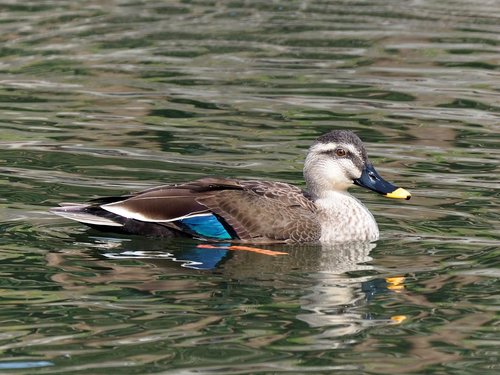
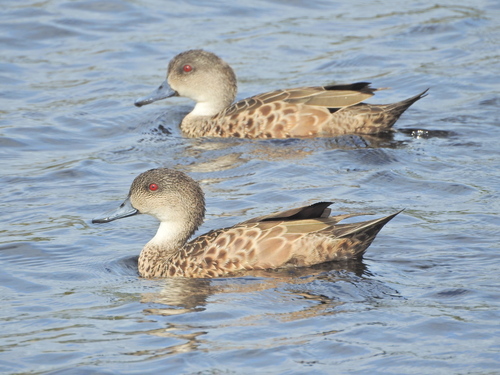
Anas gracilis (the grey teal, with Māori name tētē in New Zealand) can be identified by the crimson iris in its eyes, which is more prominent in adult males. It is a mottled brown duck with white and green flashes on its wings. Unlike the related chestnut teal—where males and females have strikingly different colouration—male and female grey teal share the same colouration. Grey teal have almost identical colouration to female chestnut teal, and can only be distinguished by their lighter-coloured neck and paler face. Juveniles are paler than adults, especially on the head, and have dull brown eyes until they reach maturity. The grey teal’s bill is blue-grey with dark lining along the edges, and its feet are grey, matching the bill colour. Its head is plain or slightly streaked, with a dark crown and cream-coloured chin, throat, and cheeks. Grey teal eggs are creamy white with no distinct speckling; the average egg measures 49.3 mm (1.94 in) in length and 35.6 mm (1.40 in) in width. Grey teal nest near their preferred freshwater lakes and marshes, usually on the ground, but also in tree holes or rabbit burrows. This is a vocal duck, especially at night; males give a soft preep, and females have a loud quack. The grey teal is a gregarious, nomadic species in Australia that rapidly colonizes suitable new habitat after rain. In 1957, large numbers left Australia for New Zealand to escape drought. Adult Anas gracilis undergo a flightless moult that does not follow a fixed annual schedule. Before the breeding season, both mature males and females undergo a body moult that excludes the wings. After the breeding season, both partners undergo a complete body moult, including the wings. According to Janet Kear (2005), moult in Australian grey teal populations is correlated with climate conditions. During a prolonged wet season, birds postpone wing moult to extend the breeding season, likely to better exploit wetland resources. This postponement occurs because ducks generally avoid moulting and breeding at the same time, and some bird species cannot do both simultaneously. Complete body moult including wings generally occurs between January and March. Juveniles undergo a full body moult that excludes the wings, which takes place in their first autumn or early winter. The grey teal was formerly classified as a subspecies of the Sunda teal, under the name Anas gibberifrons gracilis. It is widespread across its large range, and is evaluated as Least Concern on the IUCN Red List of Threatened Species. As a breeding species, the grey teal is found across Australia, New Zealand, New Guinea, and Indonesia. It also occurs as a vagrant in the Solomons and New Caledonia. It is a self-introduced species to New Zealand, having arrived from Australia where it is much more abundant. It was rare in New Zealand until the 1950s, but several natural events in Australia led to a huge increase in its population here. Now it is a very common waterbird found throughout New Zealand, with higher population concentrations in Hawke’s Bay, Waikato, South Auckland, Otago, and Canterbury regions—especially around Lake Ellesmere. It has also been recorded wandering to small New Zealand outlying islands such as the Chatham Islands (July 1951, December 1998) and Snares Islands (November 1987). Overall, the New Zealand grey teal population is smaller than the Australian population. The grey teal prefers shallow water habitats including lagoons, swamps, and shallow freshwater lakes. This preference for shallower water makes it easier for ducklings to swim and feed, improving juvenile rearing and survival. It also prefers areas with substantial marginal cover—sufficient plant and vegetation growth along habitat margins—so it is not often seen in open spaces. Although it typically chooses freshwater sites during the breeding season, it is occasionally seen in coastal salt waters and slightly brackish waters. The grey teal does not usually live in areas above 900 m (3,000 ft) above sea level, and prefers areas below 300 m (980 ft) above sea level. When nesting, it creates nests among ground-level vegetation such as reeds and tall grasses, and will also use elevated tree hollows for nesting. When establishing a pair-bond, male grey teal perform a series of displays including headshakes and head rolls. These displays mostly occur in adolescent birds before breeding season, while mature birds in established pair-bonds use courtship rituals. Grey teal form long-term, monogamous pair-bonds, staying with the same mate across multiple breeding seasons. Pairs stay together year-round, but often join large flocks for the late summer moult, remaining with these flocks until July. After breeding, they often gather at estuaries to feed on exposed mudflats. On average, grey teal begin breeding at one year old. In Australia, there is no fixed reproductive season, as breeding is linked to rainfall and food abundance, and the species has adapted to breed in shallow temporary water. In the more humid climate of New Zealand, breeding is more seasonal, though still tied to water levels. Grey teal tend to breed during the summer-rainfall period, but will also breed at any time after significant rainfall. In New Zealand, laying occurs between June and September, but replacement clutches can be laid as late as January, so breeding time seldom follows a strict seasonal pattern. Nesting is usually solitary for grey teal, though sometimes nesting sites are located close together, placing multiple breeding pairs near one another. Nests are most often found in tree hollows or hidden among ground vegetation. Grey teal do not construct nests from materials brought to the site; they only use material found at the nesting site: grass and down. Females create a ground bowl, fill it with local litter, and line the nest bowl with down. Between 1 and 7 eggs are laid in a nest at a time. Nesting occurs between June and February in South Australia, and slightly later in North Australia due to small temperature differences. In New Zealand, grey teal usually nest between September and November. During incubation, the male stands guard to protect the female and eggs, while the female incubates the clutch for 25 to 31 days. Clutch size varies, with an average clutch size between 6 and 14 eggs. Eggs are laid approximately 24 hours apart, with laying occurring early in the morning. If a pair loses a brood, they will begin laying again after only a few weeks, so some pairs may lay several clutches per season. On average, grey teal raise approximately two broods per season. Females brood young alone, but if necessary (such as after the female’s death) the male will take over brooding and raise the ducklings. Males are also often present in the later stages of brooding, as the female leaves to incubate or lay her next clutch. After hatching, parents and broods may stay close for several weeks; young become independent once they gain the ability to fly. However, siblings often stay together for a short time after leaving their parents. Fledging usually occurs between 35 and 40 days. Before fledging, ducklings are grey-brown with off-white cheeks and underparts. Both male and female juvenile grey teal reach reproductive maturity at one year old, so pair-bond formation commonly occurs in their first winter.