About Anarta myrtilli Linnaeus, 1761
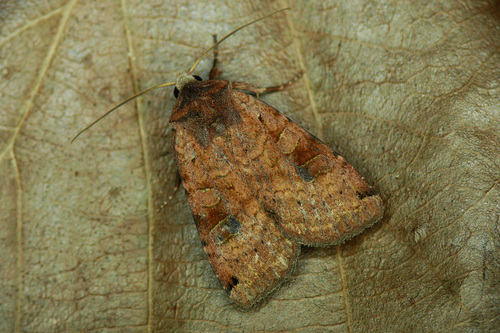
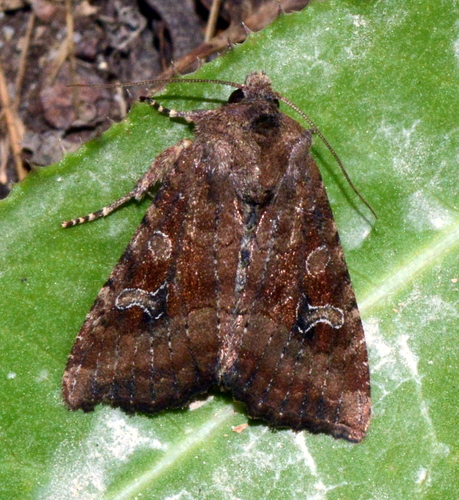
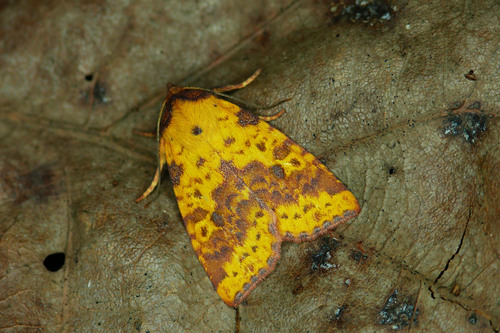
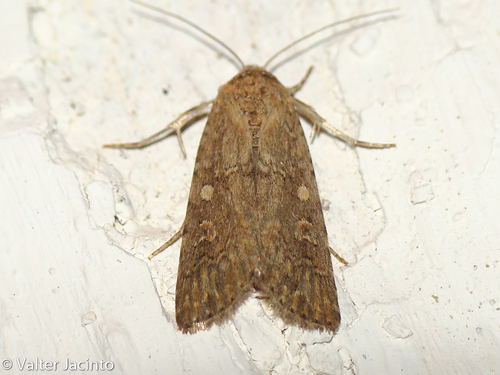
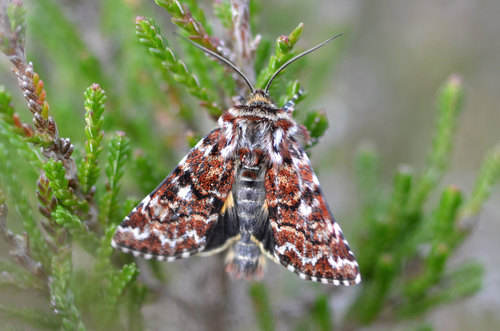
Anarta myrtilli, commonly known as the beautiful yellow underwing, is a species of moth in the family Noctuidae. It was first described by Carl Linnaeus in 1761. It can be found across most of Europe, including Scandinavia, Britain, France, Germany, Switzerland, Spain, Portugal, Italy, and Russia. This moth has a wingspan of 20–22 mm. In its typical form, the forewing is a dull dark fuscous purple with slightly paler lines, obscure stigmata, and a subtriangular whitish blotch at the base of vein 2. The hindwing is orange with a broad black terminal border; the costa and inner margin are narrowly black, and the base of the wing is often smoky blackish. This typical form is found in Sweden, northern England and Scotland, and other northern localities. It is very different from the common bright red form, which is known as ab. rufescens Tutt. In ab. rufescens, the forewing is a mixture of bright red and olive brown or olive yellow; transverse lines are more or less strongly whitish, stigmata are red brown with pale rings, and the white spot on vein 2 is distinct. ab. peralbata ab. nov. [Warren] is an extreme variant of this form, in which white lines are strongly developed, and the central area is milk white from the costa to the inner margin, including the white blotch on vein 2. On the hindwing of ab. peralbata, the yellow area is larger, and the black coloring on the costa, inner margins, and basal suffusion is reduced. ab. albivena Haw., described from specimens collected in East Anglia, has a forewing suffused with olive brown, while the wing structure remains normal. In alpina Ractzer, the forewing is olive brown, and the hindwing only displays a dull yellowish median band crossed by black veins. In olivacea Fuchs, the yellow of the hindwing is suffused with olive brown, while the forewing retains the normal bright red coloration of ab. rufescens. ab. nigrescens ab. nov. [Warren], found near Hyères in the south of France, has the typical red forewing coloration almost entirely replaced by black. The subspecies Anarta myrtilli citrina subsp. nov. [Warren], from Sintra, Portugal, has the entire forewing suffused with blackish, leaving only the white blotch on vein 2 conspicuous; the orange coloring on the hindwing, both above and below, is replaced by pale lemon yellow. This subspecies is decidedly larger than average typical A. myrtilli, and may prove to be a distinct species. Currently, only one specimen is known to have been seen: it was collected in spring 1909 by Mr N. C. Rothschild, and is now held in the Tring Museum. Adult Anarta myrtilli are on wing between May and August, with timing varying by location. There are probably two generations per year. The larvae feed on Calluna vulgaris and Erica tetralix.