About Anarrhichthys ocellatus Ayres, 1855
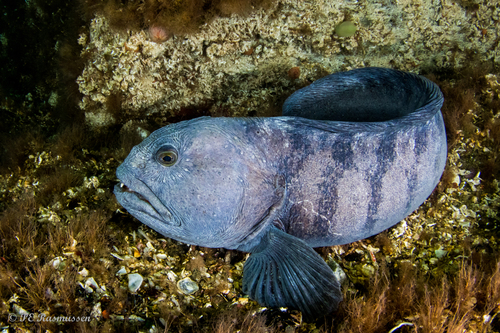
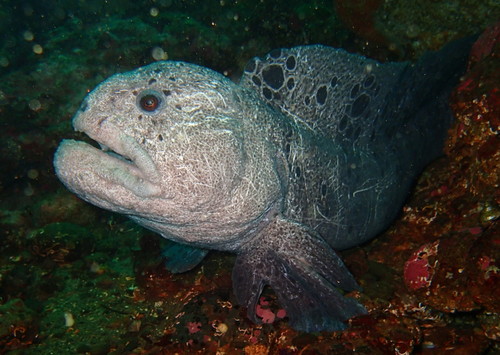
This species, Anarrhichthys ocellatus, differs from true eels in having paired gill slits and pectoral fins. Adult individuals can reach a maximum length of 2.4 m (7 ft 10 in) and a maximum weight of 18.4 kg (41 lb). Young wolf eels are orange with large dark spots on the posterior part of their bodies. As they age, their color changes to grey, brownish-grey, or dark olive. They have powerful jaws adapted for crushing prey, with canine teeth at the front of the mouth and molars at the posterior portion of the mouth. The anal fin has no rays and contains 233 radials. This species has only one dorsal fin, which extends from the head to the end of the body, and holds 228 to 250 flexible fishbones with no soft radius. The caudal fin is small. Wolf eels have no pelvic fins and no lateral line. Males have large lips and a protuberance on the upper part of the head. The typical lifespan of this species is around 20 years. Anarrhichthys ocellatus occurs in caves, crevices, and rocky reefs, ranging from shallow waters down to a depth of 226 m (741 ft). Its distribution extends from the Sea of Japan and the Bering Sea south to Northern California. Wolf eels form monogamous, lifelong pairs that occupy the same cave. They reach sexual maturity around seven years old, and reproduce from October through the end of winter. During mating, the male places his head against the female's abdomen and wraps his body around her. The female extrudes up to 10,000 eggs at a time, which the male then fertilizes. After fertilization, the female coils around the eggs and uses her body to shape the clutch into a neat sphere roughly the size of a grapefruit. The male then coils around the female. Both parents protect the eggs, and only one parent leaves the cave at a time to feed. Eggs hatch after 91 to 112 days. Throughout this incubation period, the female circulates water around the eggs to provide oxygen, and periodically massages and rotates the developing eggs. Wolf eel has edible, sweet and savory white flesh. In some coastal northwest Native American tribes, wolf eel is known as the sacred "doctorfish". Only tribal healers were permitted to eat this fish, as it was believed to enhance their healing powers.