About Anarhichas lupus Linnaeus, 1758
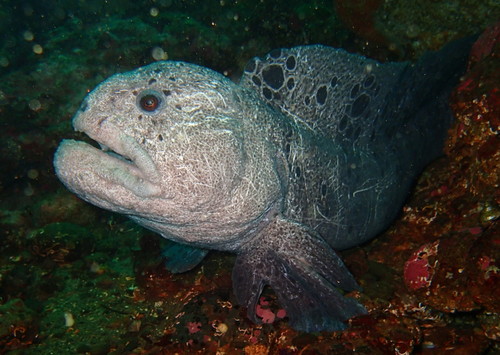
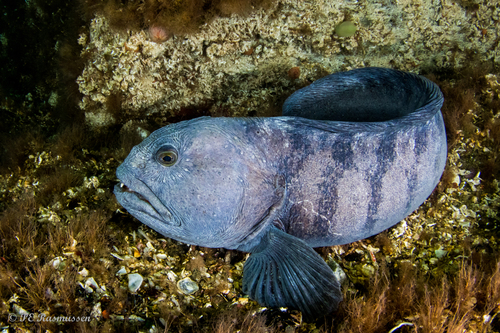
Anarhichas lupus Linnaeus, 1758, commonly called the Atlantic wolffish, retains the body shape and general external features of small blennies in the Blennioidei suborder. The largest recorded specimen of this species reached 1.5 m (5 ft) in length and weighed almost 18 kg (40 lb). Its body is long, subcylindrical at the front, compressed toward the tail, and has a smooth, slippery texture; rudimentary scales are embedded and almost completely hidden in the skin. Atlantic wolffish show color variation, most often appearing purplish-brown, dull olive green, or blueish gray. Like blennies, a continuous even dorsal fin runs the entire length of the back, and a similar fin extends from the vent to the caudal fin. Their pectoral fins are large and rounded, and pelvic fins are completely absent. Their blunt, eel-like body shape causes them to swim slowly, undulating from side to side in the same manner as an eel. The Atlantic wolffish’s defining feature, which gives it its common name, is its extensive tooth structure. This dentition separates the Atlantic wolffish from all other members of the family Anarhichadidae. Both the upper and lower jaws hold four to six strong, fang-like conical teeth. Behind the conical teeth in the upper jaw sit three rows of crushing teeth: the central row has four pairs of molars, and the outer rows hold blunted conical teeth. The lower jaw has two rows of molars positioned behind the main conical teeth. Serrated teeth are also scattered across the wolffish’s throat. Atlantic wolffish live along both the west and east coasts of the Atlantic Ocean. In the western Atlantic, they range as far north as the Davis Strait in the Canadian territory of Nunavut. They populate the shores of Greenland, Newfoundland, and Nova Scotia, and extend south as far as Cape Cod. While they are rarely seen south of Cape Cod, there have been confirmed sightings in New Jersey. The densest populations of this species are found in Georges Bank, the Gulf of Maine, and the Great South Channel. In the eastern Atlantic, their range stretches from Russia’s White Sea and Novaya Zemlya, through the Nordic countries and British Isles, down to the Bay of Biscay. There is a single recorded 1958 sighting from the western Mediterranean Sea in the Gulf of Genoa, Italy. Atlantic wolffish are mostly stationary fish, and rarely move away from their rocky habitats. They are benthic creatures that live on the hard ocean floor, and are frequently spotted in nooks and small caves. They prefer cold water, and inhabit depths between 20 and 500 m (66–1,640 ft). They are typically found in water temperatures ranging from −1 to 11 °C (30–52 °F). Because they can survive in near-freezing salt waters (salt water only freezes at temperatures slightly below 0 °C or 32 °F), they produce a natural antifreeze compound to keep their blood flowing smoothly. Three related wolffish species (Atlantic, northern, and spotted) are found in the North Atlantic. Northern wolffish have loose gelatinous flesh, but the other two species are considered valuable food fish, eaten both fresh and preserved. In Britain, they are marketed under the names "Scotch halibut" and "Scarborough woof"; in other areas of northeast Britain’s coast, they are called simply "woof", and are a popular ingredient for fish and chips. In Iceland and Norway, the Atlantic wolffish is called steinbítur or steinbit, which translates to "stone biter" in English. This name comes from the fish’s strong jaws and teeth, which can crush the hard shells of prey like shellfish and crustaceans. The way Atlantic wolffish fertilize their eggs sets them apart from many other fish species. Unlike most fish, where females release eggs into the open ocean for males to fertilize before both parents leave, Atlantic wolffish undergo internal fertilization. After fertilization, the male stays with the nest and protects the eggs for up to four months, until the juvenile fish are strong enough to live independently. Their eggs are 5.5–6.0 mm in diameter, which places them among the largest known fish eggs; the eggs are yellow-tinted and opaque. The eggs are laid on the ocean floor, often in shallow shoal water, where they stick together in loose clumps surrounded by seaweed and stones. Atlantic wolffish reach sexual maturity relatively late, at six years of age.