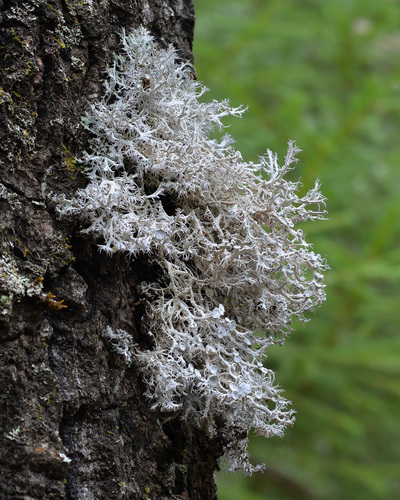
About Anaptychia ciliaris (L.) Körb. ex A.Massal.
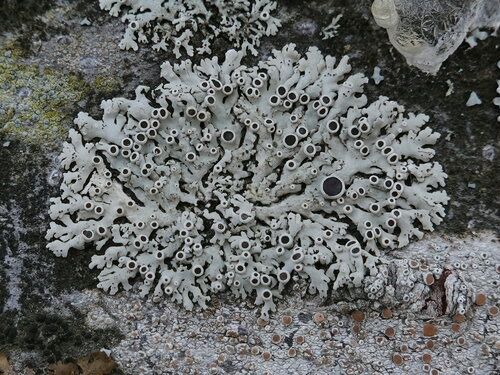
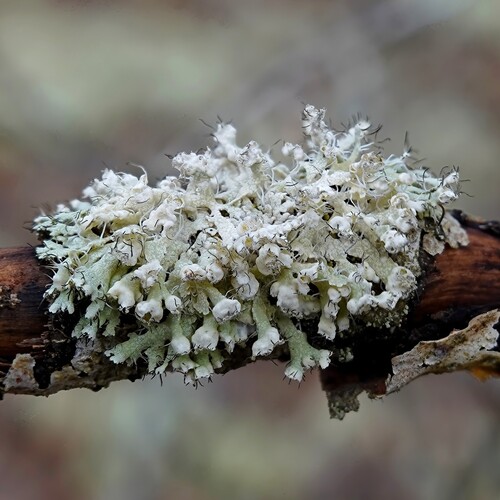
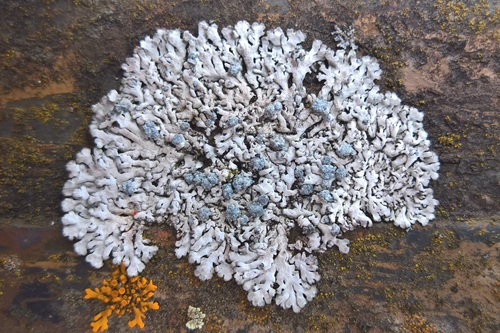
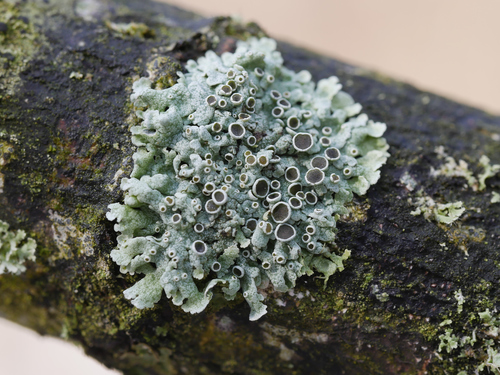
Anaptychia ciliaris (L.) Körb. ex A.Massal. is a lichen whose growth form combines characteristics of both foliose (leafy) and fruticose (bushy) lichens. Like many fruticose species, it attaches to its substrate at a single point. Its fronds, similar to the lobes of foliose lichens, lie close to the substrate and have distinct upper and lower structures in a dorsiventral organization. This structure includes an upper fibrous cortex made of tightly packed hyphae, and an algal layer with scattered photobionts located between the cortex and the medulla, which is made of looser hyphae. Its lower cortex consists of hyphae aligned more or less parallel to the thallus surface. The lichen's upper surface is greyish, while the underside can be greyish or whitish; both sides turn green when wet. Anaptychia ciliaris forms loose attachments to its substrate, which lets it develop large colonies up to 15 cm (6 in) or more across. These colonies are made up of neighbouring individuals, each with elongated, linear structures called laciniae that branch repeatedly dichotomously, splitting into roughly equal parts. The laciniae generally grow in an upward, somewhat ascending orientation. They reach up to about 2 mm (1⁄16 in) wide and around 300 μm thick, appearing either flat or somewhat convex, and are covered in soft, fine hairs (pubescence). The fibrous outer cortex gives structural strength to the laciniae, helping them stay upright. Numerous pale lateral cilia grow along the margins of the laciniae; these cilia are dark grey to black and up to 15 mm (3⁄5 in) long. Sometimes these long cilia form hapters, which are specialized aerial attachment organs with highly adhesive hyphae. When they come into contact with a nearby surface, often another lobe of the lichen's own thallus, these hapters trigger branching and form a spreading sheath, resulting in entanglement. On the undersurface of the laciniae, the thallus has no cortex and appears paler than the upper surface. The lower surface has irregular veining and is marked with rhizines—root-like attachment structures—along the margins, which match the colour of the thallus. These rhizines measure between 1 and 6 mm (1⁄16 and 1⁄4 in) in length, and may be simple or occasionally branched near their tips. The upper cortex of the laciniae has irregular thickening, and the lower surface has flexuous contours, occasionally extending downward to the lower surface of the whole thallus. The photobiont layer, which contains cells 10–15 μm in diameter, is often interrupted by the upper cortex, creating a discontinuous pattern. The medullary layer is typically very thin, and may even be evanescent in some areas. Apothecia, the reproductive structures of Anaptychia ciliaris, grow on the thallus. These structures are usually laminal (spread across the thallus surface), and are either stipitate (growing with a stalk) or somewhat sessile (attached directly to the thallus). Their diameters range from 2 to 5 millimetres (1⁄16 to 3⁄16 in). Their margins are lacinulate (tattered), with ciliate lacinules along the edges. The disc of the apothecia is brown or dark brown, and is initially covered in a white pruina that may fade over time. The hymenium of the receptacle, which is 150–200 μm tall, turns blue when stained with iodine. The hymenium's cortex is irregularly thickened and does not change colour when stained with iodine. The cylindrical or clavate asci measure about 120 by 30 μm, and usually hold between four and eight spores. Spores are dark brown, ellipsoid with rounded tips, and somewhat constricted at the centre. They measure 17–23 by 28–43 μm, with thin, uniformly thickened walls. When young, spores are oval and filled with granular and mucous substances. Over time, a central partition (septum) forms that divides the spore contents, resulting in a two-cell spore. No lichen products have been identified in Anaptychia ciliaris, and it shows no reaction to any of the standard chemical spot tests used to identify lichens. The morphology of A. ciliaris changes when exposed to harmful concentrations of ambient air pollutants: it stops producing cilia, and its lobes become shorter and develop a warty upper surface. Anaptychia ciliaris has a widespread distribution that is centered in the Northern Hemisphere. Its main range covers Europe, parts of Asia, and North Africa, and it is notably absent from North America. It is primarily found in Northern Europe, and its range extends eastward to European Russia, the Caucasus, and northeastern Russia (Murmansk). It also occurs in Central and Southern Europe, and the Canary Islands. In Africa, it is established across Morocco, and has been reported from Sudan. There are sporadic records of the lichen in Asia. In China, specimens have been collected from Xinjiang, Gansu, Shaanxi, and Hebei, at altitudes above 1,800 m (5,900 ft). In a 2018 biodiversity survey of Turkey's Lake Abant Nature Park, Anaptychia ciliaris was among the three most abundant lichens. By contrast, northern Germany and the UK have experienced a decline in sightings of the species. It is rare in Ireland, and nearly extinct in North East England. By 2010, Scotland had recorded A. ciliaris in only four locations; its scarcity is attributed to air pollution and the declining elm tree population, which has been impacted by Dutch elm disease. A century ago, it was more common in the UK, where it typically grew on trees in parklands and along cultivated roadsides. It is widely distributed in Finland, abundant in populated areas, found in parks, alleys, and field edges, and also grows on seashore cliffs. Anaptychia ciliaris can grow on a variety of substrates. When growing on bark, it is frequently recorded on Quercus rotundifolia, Q. pyrenaica, and Ulmus. Less commonly, it is found on Pinus sylvestris, P. nigra, Juniperus oxycedrus, Acer pseudoplatanus (sycamore) and Fagus sylvatica (beech). In Denmark, its usual host trees are Fraxinus and Tilia. Less frequently, it grows on calcareous and acidic rocks, and gravestones. A key characteristic of A. ciliaris is its preference for diffuse light. In Poland, Anaptychia ciliaris is one of six endangered species listed on the national red list. In the East European Plain area around Moscow, it is an uncommon species and is listed in the 2018 Red Data Book of the Moscow Region. It is mostly found in the area's birch grass-marsh forests, and its limited occurrence is attributed to air pollution from Moscow. Austria's Regional Red List also classifies A. ciliaris as endangered. It was once a common sight in Upper Austria, and its decline is caused by reduced availability of its preferred substrate: mature, moss-covered, fertilised and dust-impregnated barks. Modern forestry practices often remove trees before their bark matures to a consistency suitable for A. ciliaris growth. Historical North American literature occasionally mentions the presence of A. ciliaris, but these references are misidentifications; these records actually refer to A. setifera, and A. ciliaris is not native to the continent. In the 17th Century, "Cyprus Powder" was used as a toilette powder—a fine, often fragranced powder for personal grooming and cosmetic use—to whiten, scent, and cleanse the hair. It was a blend of oakmoss, Anaptychia ciliaris, and species of Usnea, fragranced with ambergris or musk, combined with the essences of roses, jasmine, or orange blossoms. In the Ar Kaweit region of eastern Sudan, the lichen is known locally as bakour, and is mixed with other plants and burned to repel insects.