About Anaplectoides prasina (Denis & Schiffermüller), 1775
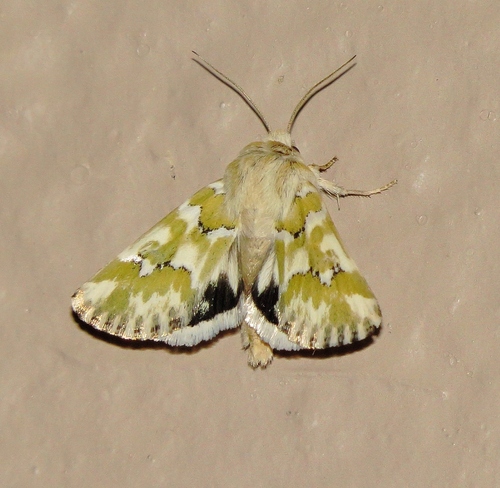
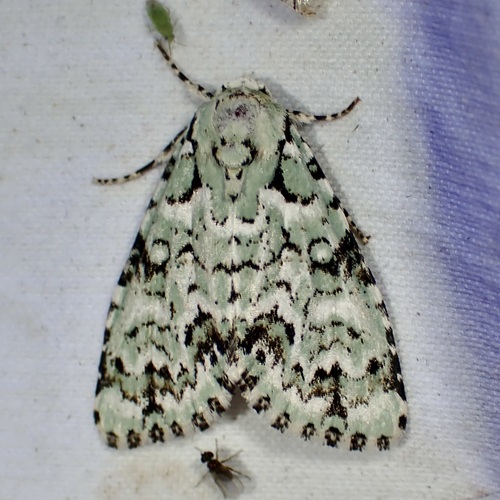
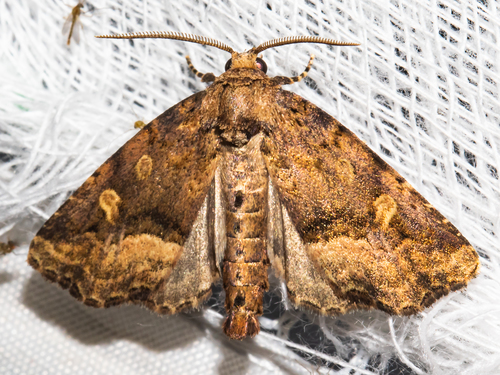
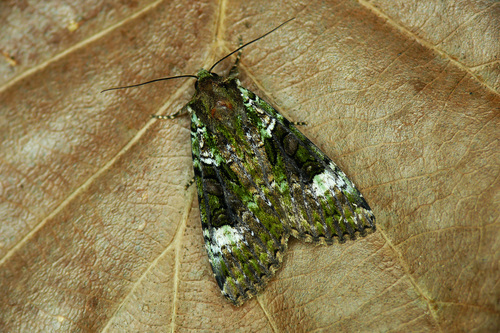
Anaplectoides prasina (Denis & Schiffermüller), 1775 has a wingspan of 40–50 mm. Its base color is green, variously tinged with dark green or blackish. There is a green-tinged cream or whitish blotch between the reniform stigma and the outer line. The stigmata are dark green, edged with black. The inner and outer lines are black, conversely edged with white, whitish green, or a color matching the surrounding tissue. The hindwing is fuscous with a paler fringe. Several distinct forms and aberrations have been described. In jaspidea Bkh., the pale patch beyond the reniform stigma is absent, and the stigmata are blacker. Ab. pallida Tutt is the extreme pale form: the whole wing is whitish green, the white patch beyond the reniform is absorbed into the pale background, and the lines and darker shades are only distinct on the costal half of the wing. Ab. suffusa Tutt is a rare form in which green tints are replaced by red brown, with the area around the stigmata blackish. In albimacula Hornmz., from Bukowina, the ground color is a mixture of dark and light grey, with the patch beyond the reniform either clear white or filled in with grey. Lugubris Petersen from Esthland is dark brownish grey with only faint traces of green or white coloring. This moth flies from May to August, with flight timing varying by location. The larva is purplish brown, with a pale dorsal line that crosses a row of blackish dorsal blotches. The spiracular line is pale, with a dark edge along its upper side. The larvae are broad generalist feeders, known to feed on both herbaceous plants and hardwoods. Confirmed host plants include blueberries, hazelnut, maples, and raspberry plants. This species is distributed from Europe east to Siberia, Central Asia, Mongolia, China, Tibet, Korea and Japan. It is also present in Armenia and the Caucasus. In North America, it occurs in southern Canada, and the U.S. locations of Washington, Oregon, northern Utah, New Mexico, New Jersey, Ohio, and North Carolina.