About Anaplectes rubriceps (Sundevall, 1850)
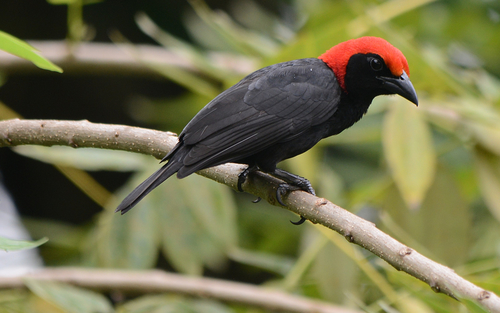
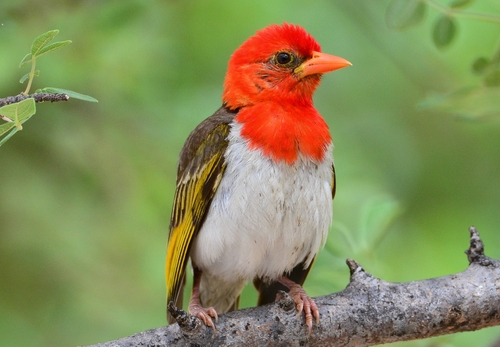
Anaplectes rubriceps, commonly called the red-headed weaver, has several consistent physical traits and noticeable plumage differences between populations and sexes. All individuals of this species have a moderately long, pointed beak and short, strong claws. Most red-headed weavers have a white belly and brown wings. Northern males of the species typically have a distinct red head that stands out to conspecific females. Northern females have a more muted brown head, while southern females have yellow heads and yellow accents on their wings. Red-headed weaver flocks usually consist of one male that stays with a group of eight or nine females. Their nests are most often built from collected dry sticks, suspended from a tree, and shaped like a raindrop. In some cases, red-headed weavers will place their nests in man-made structures. A distinct feature of this species' nests is the long entrance tunnel, which is more commonly seen in the Malimbus genus. The species is distributed across a broad range of Africa, extending from Senegambia east to Ethiopia and northwest Somalia, and south to Mozambique, northern and northeast Namibia, northern and eastern Botswana, Zimbabwe, northeast South Africa, eastern Eswatini, and northeast KwaZulu-Natal.