About Anadara kagoshimensis (Tokunaga, 1906)
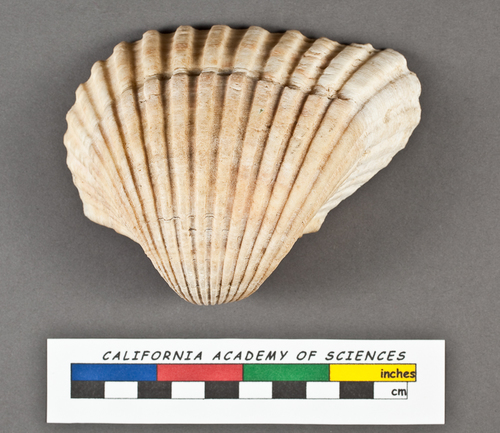
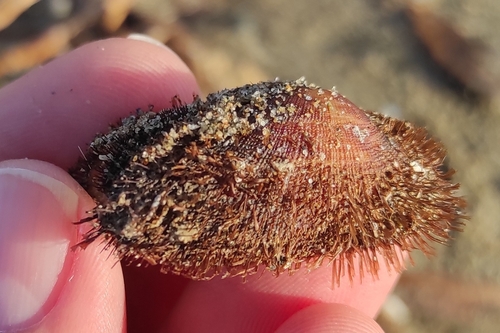
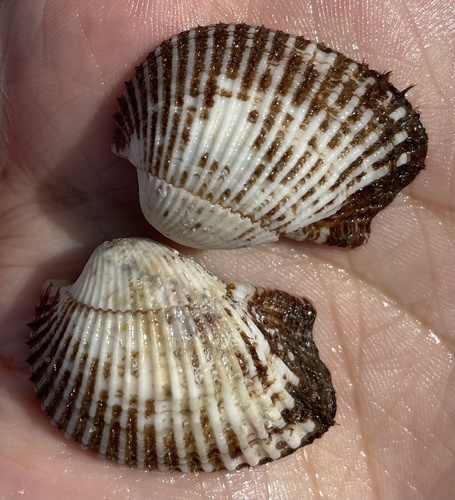
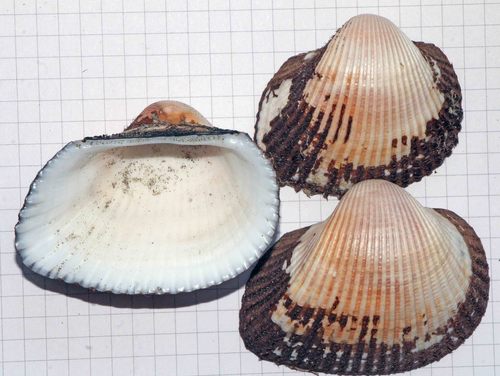
Anadara kagoshimensis has a thick, oval shell that is white or cream in color, and it superficially resembles a cockle. Its left valve is slightly more concave than the right valve, and the shell has 31 to 35 deeply indented ribs. A thin brown periostracum layer covers the shell, and this layer flakes off in strands. When harvested for human consumption, this species typically measures between 30 and 45 millimetres (1.2 to 1.8 inches) in length. This species is found along the coasts of Japan and South Korea, where it buries in soft sediments in the subtidal zone. It prefers mud or muddy sand substrates. Some authorities state that the larvae, called spats, require hard materials such as stones and shells to attach to using their byssal threads, while other authorities claim that the larvae do not need hard substrates to settle. Anadara kagoshimensis is tolerant of low salinities, and prefers waters with a salinity of 29–32 ppt. Larvae are planktonic, and prefer even lower salinities between 24.6 and 30 ppt, and tend to gather in estuarine waters with this salinity level. This clam grows well in waters with temperatures between 5 °C and 28 °C. It can also tolerate the low dissolved oxygen levels found in tidal waters that flow over mud flats. This tolerance may be supported by the haemoglobin and erythrocytes present in its blood.