About Anacharis zealandica Ashmead, 1900
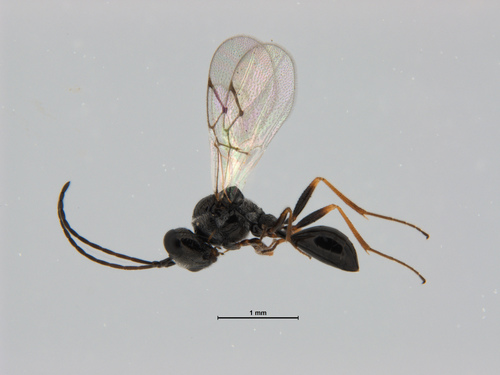
Anacharis zealandica has a pair of eyes positioned on the sides of its head; this arrangement provides optimal peripheral vision, letting it detect both prey and predators approaching from any direction. This eye structure is also found across all wasp species and in members of the order Diptera. The body of Anacharis zealandica has a glossy, shiny appearance, and its legs are a lighter shade of brown than its body. It has two pairs of wings, all of which are transparent, scaly, and thin, with one pair larger than the other. Adult Anacharis zealandica are typically around 5mm long, with an approximate head width of 0.5mm. Like many other members of the order Hymenoptera, Anacharis zealandica uses hairs covering its body to enhance its sense of smell and taste. It has a thin connecting waist (called a petiole) between its abdomen and thorax, three pairs of jointed legs, and one pair of jointed antennae. Due to the species' small size and rarity, no information on larval identification is currently available.
Geographically, Anacharis zealandica is native to New Zealand. On New Zealand's North Island, it has been recorded in Bay of Plenty, Coromandel, Hawke's Bay, Auckland, Taranaki, Taupo, Whanganui, Northland, Waikato, and Wellington. On the South Island, it has been found in Central Otago, Dunedin, Kaikoura, Buller, Mid Canterbury, Mackenzie, Nelson, Marlborough, South Canterbury, Marlborough Sounds, Southland, Westland, and Otago Lakes. The species also occurs across multiple regions of Australia: it has been documented in South Australia, Queensland, New South Wales, the Australian Capital Territory, Tasmania, Victoria, and Western Australia, and has not been recorded only in the Northern Territory. Anacharis zealandica has also been found on the Kermadec Islands, Snares Islands, Three Kings Islands, and Chatham Islands, all offshore island groups belonging to New Zealand.
As larvae, Anacharis zealandica develop as parasitoids inside the brown lacewing Micromus tasmaniae, which gives the species its common name: the lacewing parasitoid wasp. Larval Anacharis zealandica feed on energy reserves from their lacewing host, which is large enough to support the larva and sustain both species during development. Micromus tasmaniae prefers temperate weather conditions, lowland shrubs and open bush with low canopy cover, and avoids hotter climates. As Anacharis zealandica depends on this host to survive, it has adapted to these same habitat conditions. As adults, Anacharis zealandica prefers slightly cooler temperatures and areas with low canopy cover. The flowering plant Fagopyrum esculentum (buckwheat) is also strongly associated with the species, as its flowers provide resources for both Anacharis zealandica and its host.
The life cycle of Anacharis zealandica begins as an egg laid inside Micromus tasmaniae. The egg stage lasts roughly 4 to 10 days, after which eggs hatch into parasitoid larvae that focus on feeding on their host. The larval stage lasts approximately 13 to 17 days, followed by a pupal stage that lasts 7 to 19 days. Once development is complete, the wasp emerges as a free-living independent adult. Adult Anacharis zealandica live for approximately 2 to 3 weeks. Variation in the length of each life cycle stage is caused by differences in habitat and living conditions. Adult Anacharis zealandica feed on flower nectar from plants including buckwheat, which classifies the species as a life-history omnivore. Feeding on buckwheat nectar also helps adult Anacharis zealandica live longer.

