About Anacamptis morio (L.) R.M.Bateman, Pridgeon & M.W.Chase
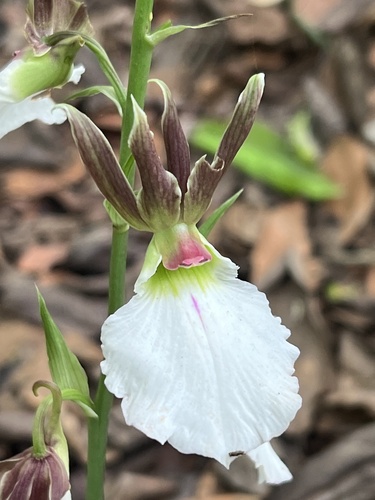
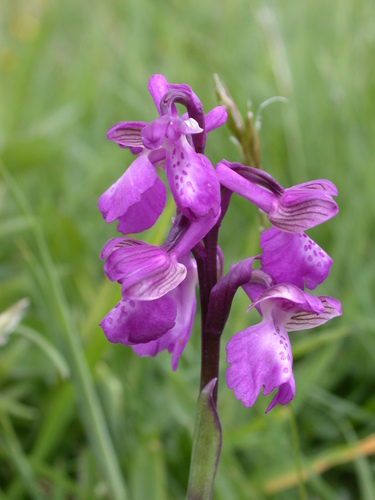
This orchid species, Anacamptis morio, flowers from late April to June in the British Isles, and can flower as early as February in other countries like France. Its inflorescence comes in a range of colors, mainly purple, and spans from white through pink to deep purple. Between 5 and 25 helmet-shaped flowers grow in a loose, linear cluster at the top of a single stalk. A pair of lateral sepals with prominent green, occasionally purple veins extend outward laterally like "wings", which gives the orchid its common name. The broad, three-lobed lower petal is pale in its center with dark spots. Leaves are lanceolate, or sometimes ovate, and grow in a rosette around the base of the plant, with some thinner leaves that clasp the stem and sheath it almost up to the flowers. Leaves are green and unspotted. Plants reach up to 40 cm in height. Anacamptis morio is similar in appearance to Orchis mascula, the early purple orchid, which flowers around the same time of year. However, Anacamptis morio has green stripes on its two lateral sepals, and lacks the spots or blotches found on the leaves of the early purple orchid. Individual plants can flower for up to 17 years. This species is native to western Eurasia, ranging from Europe to Iran, and to Northern Africa from Morocco to Tunisia. In the British Isles it occurs in central-southern England, Wales and Ireland. It grows in unimproved grassy meadows, especially on limestone-rich soil. It thrives in areas where grass is cut once or twice a year after flowering finishes, or where the area is grazed after flowering finishes. Cutting or mowing should not happen immediately after flowering, to leave enough time for seed dispersal. It can grow in both dry and wet grazed meadows, and can also be found in coastal grasslands, quarries, churchyards, roadsides and lawns. On the European continent, it also grows in alpine pasture and in xerothermic grassland on porphyry outcrops. Its maximum recorded altitude is between 1500 and 2000m. Bees act as pollinators for this species. Its flowers do not produce nectar, but attract pollinators through their visual appearance. This nectar deception facilitates pollen mixing between different individual plants, promotes genetic diversity in the species, and has been favored by evolution over nectar production. Individual plants cannot become established without a mycorrhizal partner. This makes the species vulnerable to chemicals, particularly fungicides, as well as other chemical applications including fertilisers that can reduce the population of specific mycorrhizal fungal species. The known mycorrhizal fungi that associate with this green-winged orchid are Epulorhiza repens from the family Tulasnellaceae and Moniliopsis solani from the family Ceratobasidiaceae.