About Anableps dowei Gill, 1861
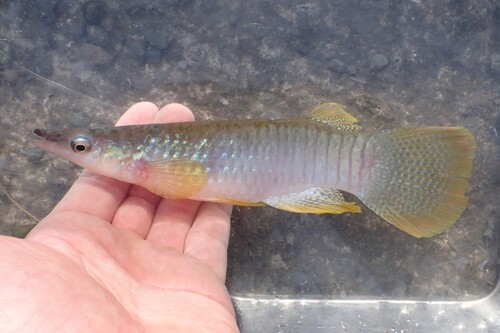
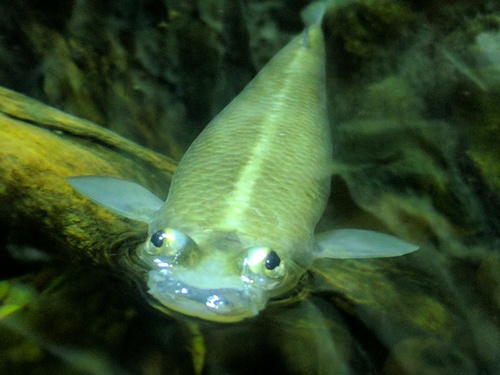
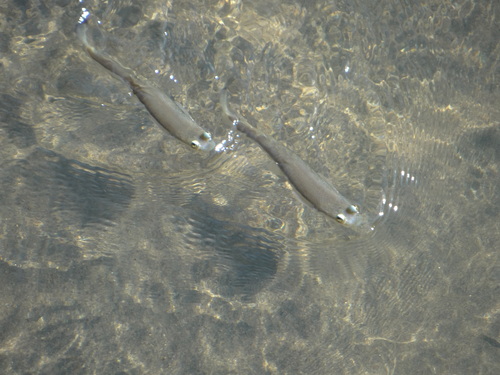
Anableps dowei (also referenced as Anableps dowii) has a slender, elongated body with large eyes that protrude from the top of the head. The cornea and irises of the eyes are horizontally divided into two differently-sized apertures: the larger, higher lobe is specialized for above-water vision, while the smaller, lower lobe is specialized for vision below water. This fish has specialized muscles that let each eye adjust its focus independently, improving its ability to adapt to both aerial and aquatic environments. A. dowei has a dark brown body, with a broad, cream-colored stripe that runs along the sides and a yellow ventral surface. The species has a single, small, posteriorly-positioned dorsal fin with 7 to 10 rays, large paddle-like pectoral fins, abdominally-placed pelvic fins, an anal fin that becomes a specialized gonopodium in mature males, and a large, rounded caudal fin. Anableps dowei can be distinguished from the other two members of the genus Anableps, A. anableps and A. microlepis, by its Pacific distribution (the other two species have Atlantic distributions) and the presence of a cream-colored stripe along the side of the body. Anableps dowei ranges as far north as the basin of the Rio Tehuantepec, Oaxaca, Mexico, and as far south as Nicaragua, occurring across Mexico, Guatemala, El Salvador, Honduras, and Nicaragua. The species lives in waters ranging from inland freshwater canals and tributaries to estuaries and brackish coastal lagoons. In terms of elevation, the species ranges from sea level (0 m) to 670 m in Honduras. Anableps dowei is insectivorous. During low tide, the fish will crawl onto shore to eat algae and other organic matter. The species stays at the surface of shallow water 1 to 5 meters deep, with the air-adapted lobe of its eyes kept out of the water, and occasionally dives to prevent the upper part of the eyes from desiccation. The species lives in waters that are sparsely vegetated to completely unvegetated, with soft substrates made of sand or mud. A. dowei typically lives in water with a temperature between 24 and 28 degrees Celsius. The species forages for insects and invertebrates at night. It will jump out of the water to catch insects flying above the surface, and this jumping also serves as a method of threat evasion. Jumping is most commonly seen in large individuals, primarily females; smaller individuals usually evade threats by diving down away from the water's surface. Anableps dowei performs schooling behavior. Younger individuals form schools of 10 to 200 individuals, while larger adults live alone or in small groups. Anableps dowei is viviparous, meaning it bears live young. Males have a prominent, tubular gonopodium that develops from the anal fin, and this structure is used to impregnate females during mating; its presence indicates gonadal maturity in males. Like other members of Anablepinae, this livebearing species has genitals that lean either left or right, a trait that prevents inbreeding. For any given individual, the direction the male gonopodium leans is determined stochastically, not by genetics or environmental factors. Females can give birth to more than 14 young per brood. Anableps dowei is the most primitive member of its genus, a trait reflected in its production of incomplete sperm packets, unlike the free sperm produced by other Anableps members. Anableps dowei breeds year-round, though in El Salvador the species shows seasonal variability in reproduction that peaks in May. Reproduction has been observed in lagoons, which may act as nursery habitat for juveniles.