About Anableps anableps (Linnaeus, 1758)
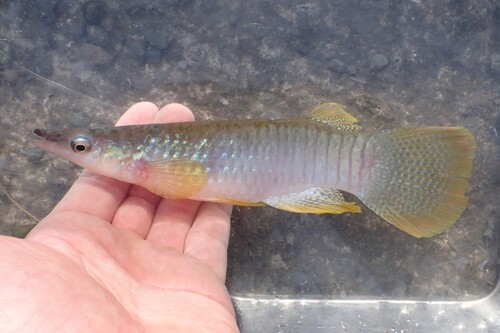
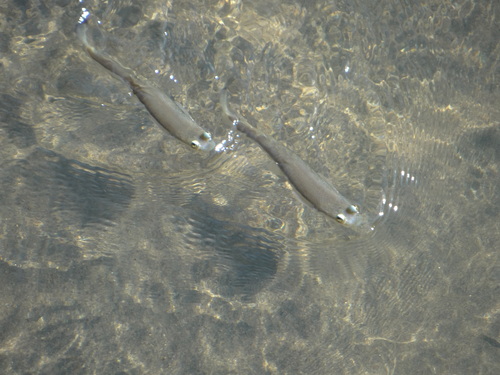
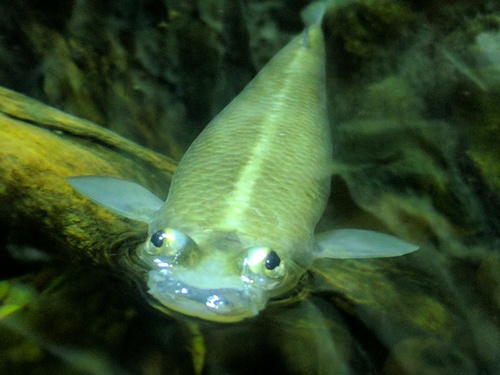
Anableps anableps (Linnaeus, 1758) is a slender, elongated fish with very distinctive eyes that project prominently from the head. Each eye is split lengthwise, giving the fish two pupils; the fish positions itself so the dividing line between the two sections of the eye sits at the water surface, leaving one pupil with an aerial view while the other remains submerged. It is brown with countershading, and shows clear sexual dimorphism. Females are larger and heavier than males: females average 18.5 cm (7.3 in) standard length (SL) and 80 g (2.8 oz) in weight, while males average 14.5 cm (5.7 in) SL and 31 g (1.1 oz). Maximum sizes for females reach 24.5 cm (9.6 in) SL and 200 g (7.1 oz), and the largest recorded males reach 18.5 cm (7.3 in) SL and 70 g (2.5 oz). The most notable sexual difference is the presence of a gonopodium: juveniles and adult females have a standard anal fin, while males have their anal fin modified into an intromittent organ tipped to one side, called a gonopodium, which is used for reproduction. Adult females have 11 anal fin rays, with rays 1–3 and 11 being unbranched. Females also have a modified scale called a foriculum that covers either their left or right genital opening. A. anableps can be told apart from other species in its genus by its small number of large scales. Another identifying trait is the number and color of its lateral stripes: these stripes are blue or purple, and run between the pectoral and pelvic fins. There are typically 3 prominent stripes, though up to 5 may be present. Females of this species are the only ones in the genus that possess a foriculum. Anableps anableps is found in the tropical western Atlantic Ocean and the southern Caribbean Sea. Its range extends from Trinidad and Venezuela to the Amazon River delta in Brazil, though some sources note populations as far south as Brazil’s Bay of All Saints, and some populations located far inland. It occurs most often in estuaries and coastal mudflats, where it shares habitat with A. microlepis. Unlike A. microlepis, A. anableps can survive in freshwater environments for long periods. Anableps anableps typically stays near the water surface, using its unique eyes to see both above and below the water at the same time. It rarely dives below the surface, though it must periodically submerge its eyes to prevent them from drying out. This species forms schools of 10 to 50 individuals. It is a generalist feeder, eating insects, other small invertebrates such as small crabs, small fish, and algae. A large portion of its diet is made up of detritus, while insects make up the highest diversity of its prey items. It has occasionally been observed jumping out of the water to catch flying insects, and otherwise feeds on prey at or near the water surface. It also ingests silt, consuming diatoms, mussels, and isopods from the silt grains. It sometimes leaves the water to feed on mudbanks. In the water, A. anableps captures prey using a combination of biting and suction. It feeds by lowering its lower jaw and protruding its upper jaw, then sucking prey into its mouth. If prey is too large to swallow, it grips the prey with its teeth, retracts its upper jaw, and bites the prey. This cycle of protrusion and biting can repeat until the prey is small enough to swallow. There is also evidence that this species uses a degree of ram feeding for small prey. When the fish beaches itself to feed on land, it uses a different feeding mechanism: it positions its head above the prey, rotates its lower jaw more than 180 degrees, then protrudes its upper jaw downward to bite the prey. This mechanism is similar to the picking behavior seen in other Cyprinodontiforms. In mangrove areas of Brazil, this species follows a daily migration pattern synchronized with the tides: as the tide rises, it moves into intertidal channels to feed in inundated mangroves at high water, and retreats to main channels as the tide falls. The highest feeding intake occurs around high water during daylight spring tides, and the lowest during night-time neap tides, which may reflect the importance of its vision for feeding. In this region, red intertidal algae (Catenella sp.) is the main food item, supplemented by insects and shore crabs of the family Grapsidae. A. anableps is parasitized by praniza larvae of gnathiid isopods, which attach to the fish’s gills and skin to feed on its blood. Parasite prevalence varies between populations; one study recorded infection in 42.3% of individuals in a surveyed area. This species is also parasitized by the copepod Acusicola rochai, a member of the family Ergasilidae, with infection rates as high as 66% of individuals reported. Like other members of its family, Anableps anableps is viviparous, meaning it uses internal fertilization and gives birth to live young rather than laying eggs. Individuals of this species can reproduce multiple times each year, though some evidence suggests the later months of the year are preferred for reproduction. Females carry between 1 and 37 eggs, which remain and develop as embryos inside the ovarian follicles until the yolk sac is absorbed and the young are born. The ovaries and follicles change significantly in size and structure to accommodate growing embryos, returning to their pre-pregnancy state after birth. Unlike A. microlepis, all embryos in A. anableps are fertilized and develop at the same time, and new eggs cannot be fertilized until the current brood is born. In males, the anal fin rays develop into a long bony gonopodium, which is used to deposit sperm. The anal fin rays curve to form an asymmetrical cylindrical structure that almost fully encloses a sperm duct, a trait that distinguishes the gonopodium of this species from the gonopodia of the Goodeidae and Poeciliidae families. The tip of the gonopodium bends to either the left or right side of the fish. During gonopodium development, an extra anteriormost anal fin ray forms that is not present in females or juveniles. Females of this species usually have asymmetrical genitalia. This asymmetry comes from the foriculum, a modified scale that covers the oviduct behind the vent. The foriculum only opens to one side, so right-handed males can only mate with left-handed females, and vice versa. Right and left-handed individuals of both sexes are found in roughly equal proportions in the wild. Breeding experiments with this species suggest that the left- or right-handed orientation of the gonopodium is determined randomly, is not heritable, and is not dependent on environmental conditions. Researchers commonly study this species for its unique eye structure. Its unusual appearance has attracted public attention, and it appears in many films, lectures, public aquariums, and home aquaria. Despite its presence in the aquarium trade, the IUCN classified Anableps anableps as Least Concern in 2020, though no specific population trends are currently known.