About Amytornis striatus (Gould, 1840)
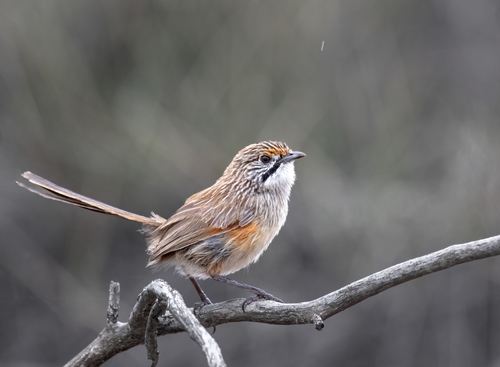
The striated grasswren (scientific name Amytornis striatus (Gould, 1840)) is one of 14 species in the genus Amytornis, which are commonly called grasswrens and found only in arid and semi-arid areas of Australia. All grasswrens are small, cryptic birds with long, usually cocked tails. They are characterized by a distinctive diagnostic interscapular gap in their feathering, an enlarged auditory bulla (tympanic chambers), and ten rectrices. The striated grasswren is a slim, long-tailed grasswren with a slender pointed bill. Its plumage is highly variable across its range, matching the colour of local soil and rock. The species shows slight sexual dimorphism: females have a brighter rufous flank patch. All populations have soft red-brown upperparts streaked with white, an orange-buff eyebrow and fore-supercilium, a white throat, a bold black submoustachial stripe, and a buffish underbody. Like other grasswrens, they have short rounded wings and cannot fly long distances. They typically flit or hop between perches within vegetation, and run or hop across the ground in a series of fast jerky movements. While striated grasswrens are closely related to the well-known fairy-wrens of the subfamily Malurinae, they are larger (17–20 grams compared to 6–16 grams for fairy-wrens) and more sombrely coloured, with variably prominent white streaking across plumage in shades of brown, rufous, and black. Striated grasswrens are most often seen in pairs, sometimes as single individuals, and often in small groups of up to five birds. They are unobtrusive, shy, and typically hard to approach, and are often first detected by their calls. During the breeding season, breeding birds may be inquisitive towards intruders in their territory. The striated grasswren is the most widespread species of grasswren. Its range extends across northern South Australia, through central and southwestern New South Wales, northwest Victoria, and into southern and eastern South Australia. Populations of striated grasswren are strongly associated with sandplains, dunes, and stony hills dominated by spinifex (Triodia) grass, with or without an overstorey of shrubs such as grevillea, Hakea, acacia, banksia, or mallee eucalypts. Spinifex provides critical foraging habitat, protective nesting sites, and cover for this species, and also for most other species of grasswren. Striated grasswrens show a preference for areas with large spinifex hummocks that are 25–40 years post-fire, though the species has also been found occupying areas that are 6 to 8 years after fire. Striated grasswrens are most often recorded in pairs, and sometimes in groups of 3 up to 10 birds. It is thought that pairs or family groups are more common outside the breeding season, and may range more widely across suitable habitat. Cooperative breeding, which is seen in other members of the Maluridae family, has not been recorded in wild striated grasswrens. In captivity, members of family groups have been observed allopreening, sunbathing together on branches, bathing in dry soil and fine water mists, and chasing one another around. Breeding usually occurs between July and November, but breeding outside this window is likely to happen after sufficient rainfall, particularly in central and northern Australia. The nest is a bulky domed structure built from spinifex spines, lined with bark strips, grass, plant down, and feathers. It is positioned close to the ground, well concealed, and usually placed inside a spinifex tussock. The eggs are rounded oval, white to pinkish-white, with a finely textured surface and sparse markings of purplish-red spots and blotches that are concentrated mostly at the larger end. Clutches contain 2 eggs, rarely 3. The female incubates the clutch for 13–14 days. After hatching, both parents are equally active in feeding chicks and removing faecal sacs. Chicks fledge at 12–14 days old, and remain hidden in dense cover close to the nest for 3–4 days after fledging. They do not gain full independence until a further 3 to 4 weeks. Striated grasswren nests are known to be parasitized by three cuckoo species: Horsfield's bronze cuckoo (Chrysococcyx basalis), black-eared cuckoo (Chrysococcyx osculans), and fan-tailed cuckoo (Cacomantis flabelliformis).