About Amyris elemifera L.
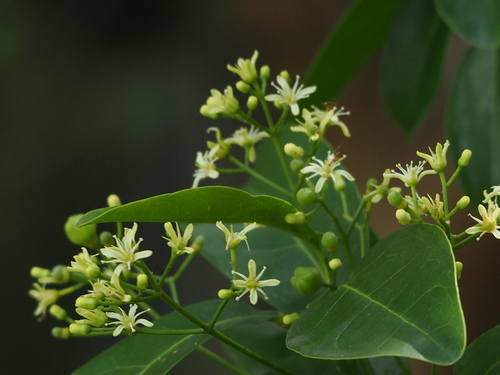
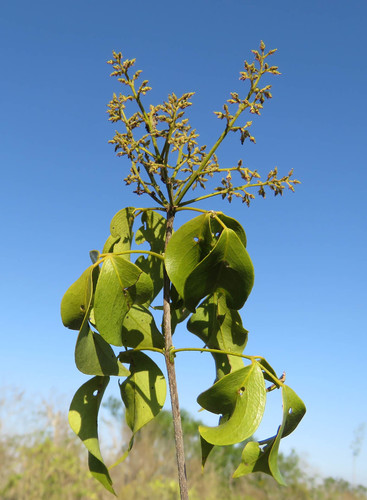
Amyris elemifera L., commonly called sea torchwood, reaches an average maximum height of 4 to 12 metres (13 to 39 ft), and can grow up to 15 m (50 ft) in ideal conditions. Its bark starts smooth and gray, and becomes rough, furrowed, and plated as it matures. Sea torchwood produces close-grained wood, and has a vertical branching pattern. It has a weak taproot, but its lateral roots are stiff and strong. Yellow-gray twigs turn fully gray as they age. The hanging foliage of this species is fragrant. Its compound leaves grow opposite or sub-opposite; a 3 cm (1.2 in) petiole supports three to five oval or lance-shaped leaflets. For ecology, sea torchwood tolerates full sun to light shade, and grows well across many soil types as long as sites are well-drained. In Puerto Rico, it thrives in areas that get 750 to 2,000 mm (29.53 to 78.74 in) of annual precipitation. It often grows in soil over rock or on coastal sand, and occupies hammock edges in Florida. Young sea torchwood plants stay in the understory until canopy gaps allow them to grow further. This species has been used for fences, fuel, and honey production. Its fine-grained, fragrant wood is resistant to dry wood termites, but it is too scarce to be widely used. The plant has been found to contain taxaline, an oxazole with antibiotic activity against Mycobacterium. Sea torchwood produces tiny, fragrant white flowers. It forms fragrant, globose black drupes that each hold a single brown seed. Both the flowers and fruit attract wildlife including birds. In Florida, sea torchwood is a food source for the endangered Schaus' Swallowtail (Papilio aristodemus ponceanus). Contrary to popular belief that aligns with its common name, sea torchwood has very low tolerance to salinity.