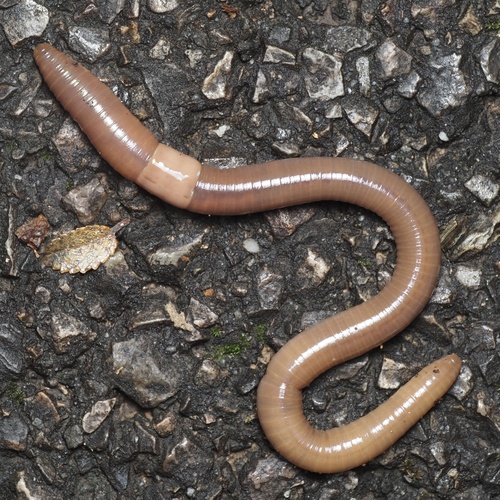
About Amynthas agrestis (Goto & Hatai, 1899)
Amynthas agrestis, commonly called the Asian jumping worm, is a species of earthworm in the family Megascolecidae. It has a smooth, glossy grey or brown body, with a milky-white, collar-like clitellum located 14 to 16 segments away from the head. The clitellum has a thick, raised, pale appearance. Adults can range from 1.5 to 8 inches (3.8 to 20.3 cm) in total length, and most mature individuals measure 10 to 13 cm, or 3 to 5 inches. When disturbed, this worm moves back and forth in a snake-like thrashing motion that mimics snake movement; it can also break off tail segments to help escape predators. This behavior has earned it the nicknames 'crazy worm' and 'snake worm'. This species is native to Japan, Korea, and Taiwan. It was introduced to North America via increased human activity in the 19th century, and is classified as an invasive species in the United States. Worms of the genus Amynthas, commonly called jumping worms, grow and reproduce more quickly than European earthworm species. A. agrestis is an epigeic species, meaning it lives and feeds within leaf litter and the top few inches of topsoil. A key ecological concern related to this invasive species is its excessive consumption of leaf litter, which reduces both native soil microbiological diversity and overall species richness in affected areas. Loss of leaf litter makes native plant roots less anchored, leaving plants more vulnerable to being washed away by rain. Removing organic material from topsoil also alters soil structure, reduces the soil’s ability to hold water, and stunts plant growth. Unlike many other earthworm species, A. agrestis does not burrow deeply and stays primarily in topsoil, so it contributes very little to soil aeration. Its worm castings have a texture resembling coffee grounds. Ecological experts have developed management strategies for this invasive species; controlled burning is a primary method used to reduce populations in grassy areas and some woodlands, as it removes the species’ main food source (leaf litter) to control population growth. The Asian jumping worm has an annual life cycle. It spends at least six months of the year in the larval stage, and adults emerge between May and August, with a reproductive maturity period of up to 60 days. Young worms hatch from egg-filled cocoons between April and May. The cocoons are similar in size and appearance to mustard seeds, which makes them difficult to spot and allows them to camouflage effectively in soil. Between August and September, mature worms reproduce and deposit eggs into surrounding soil. Most adult worms die from freezing temperatures by this point in the year. Eggs overwinter inside their protective cocoons, which can withstand cold winter temperatures even after adult worms have died. When temperatures rise above 10 °C (50 °F) in early to mid-spring, young worms emerge from the cocoons. Newly hatched worms are initially tiny and translucent, but they grow rapidly as they feed on organic matter and leaf litter, drastically altering the structure of affected soil as they feed. They reach maturity in approximately two months, usually by midsummer. Adults can be easily identified by the smooth, milky-white clitellum that completely encircles the body. This species reproduces via parthenogenesis, which allows populations to grow rapidly because every individual can produce cocoons without needing to mate. By late October, falling temperatures kill all adult worms, leaving only the hardy cocoons in the soil to overwinter. The cycle repeats the following spring when a new generation of worms emerges.

