About Amylocystis lapponica (Romell) Bondartsev & Singer
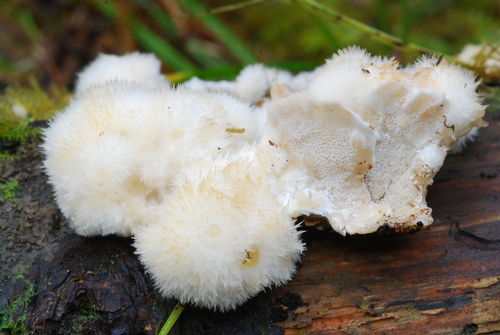
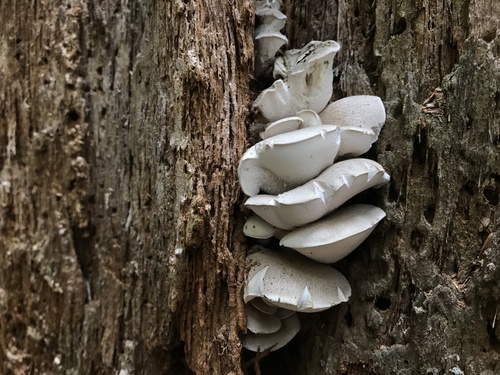
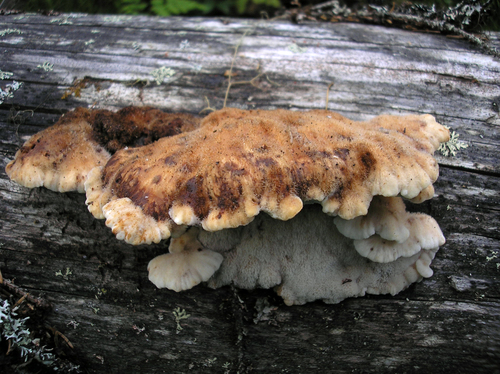
Amylocystis lapponica produces fruit bodies that vary in form from crust-like to effused-reflexed, which is mostly crust-like with edges that curl out to form rudimentary caps. Individual fruit bodies can grow up to 15 cm (6 in) wide, and have a surface color that ranges from dirty whitish to light buff, which turns reddish brown when dried or bruised. This fungus has a monomitic hyphal system made up entirely of generative hyphae. These hyphae are mostly thick-walled and measure 4–10.5 μm thick. Its spores are cylindrical, hyaline, and smooth, with dimensions of 8–11 by 2.5–3.5 μm. Spores do not react to Melzer's reagent. Oligoporus fragilis looks similar to Amylocystis lapponica, but can be distinguished microscopically by its lack of amyloid cystidia. Amylocystis lapponica decomposes fallen conifer wood, and causes brown rot in this wood. Its preferred host trees are spruce and larch, though it occasionally grows on fir. It has a circumboreal distribution across coniferous forests. In Europe, the fungus is almost entirely restricted to old-growth forests. Local populations require several specific conditions to survive: vegetative continuity with no logging history, natural tree species composition, a multi-aged forest structure, abundant dead wood in multiple decay stages, a relatively large area of virgin forest surrounded by near-natural forest, and a stable, cold, humid mesoclimate and microclimate. Due to these strict requirements, the species is rare. For example, the Czech Republic has a long, intensive history of studying polypores, yet A. lapponica has only been recorded from Boubínský prales virgin forest, even though other old-growth forests exist in the country. Similarly, in Poland it is only known from Białowieża Forest within Białowieża National Park. Both the Czech and Polish sites share a similar management history with minimal human influence. Unlike its rarity in Central and Southern Europe, A. lapponica is found at hundreds of locations in Finland and Sweden, and dozens of locations in Norway. In these regions, the fungus is used as an indicator species to help assess areas that require conservation. The fungus is widely distributed across western North America, and also occurs in China. Across Europe, the fungus has been recorded in 12 countries, and is red-listed in 7. In 2004, the European Council for Conservation of Fungi proposed Amylocystis lapponica as one of 33 species for protection under the Bern Convention. It is considered critically endangered in both the Czech Republic and Poland, where it appears on regional red lists and is protected by law. The discomycete Hyaloscypha epiporia only grows on the surface of old polypores that fruit on softwood, and it is commonly found on old, partially decayed fruit bodies of Amylocystis lapponica.