About Amyema quandang (Lindl.) Tiegh.
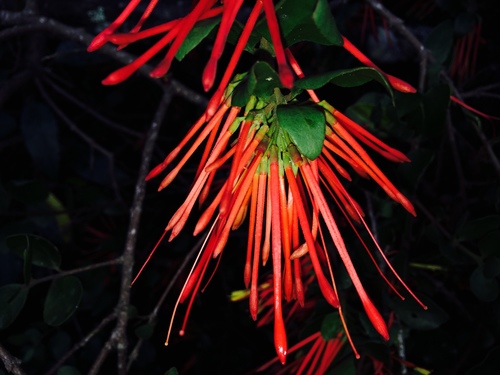
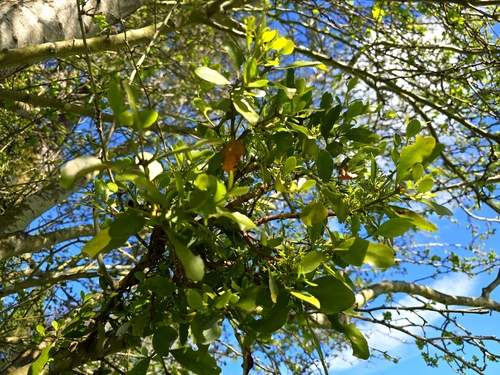
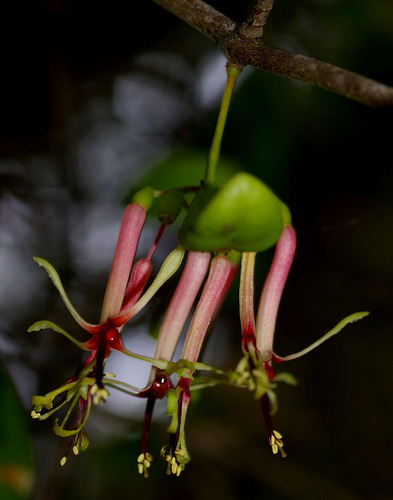
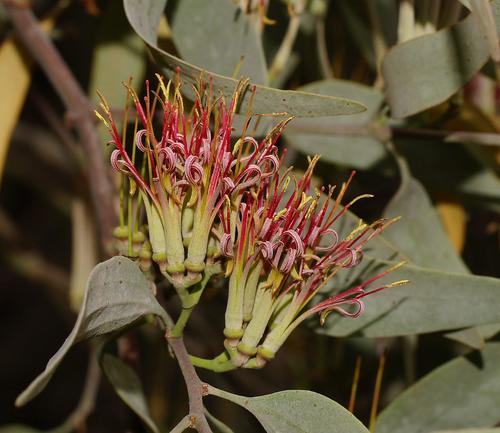
Amyema quandang (Lindl.) Tiegh. is an aerial shrub that lacks conventional roots and grows attached to the stems of Acacia species. Its leaves are leathery, greyish, and shaped from lanceolate to broadly ovate. Its flowers show combinations of red, green, and grey, and bloom between April and October. Its fruit is a fleshy drupe 6 to 10 millimetres long that holds a single oily seed. This species has a hemi-parasitic relationship with Acacia, and has been recorded growing specifically on Acacia aneura, A. cambagei, A. papyrocarpa, A. omalophylla, and A. dealbata. In the arid interior of Australia, two bird species share mutualistic interdependence with this plant. Nectar from A. quandang forms an important part of the diet of the spiny-cheeked honeyeater (Acanthagenys rufogularis), and this bird assists the plant with pollination. The mistletoebird (Dicaeum hirundinaceum) eats the plant’s fruit and disperses its seeds; other fruit-eating birds do not consume the year-round available fruit of this species. Rare among members of the Loranthaceae family, this species can hybridize with Amyema pendula to produce first-generation hybrids.