About Amyda cartilaginea (Boddaert, 1770)
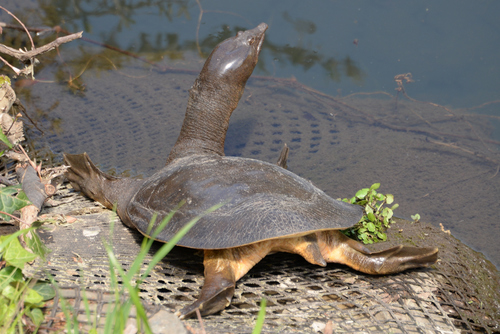
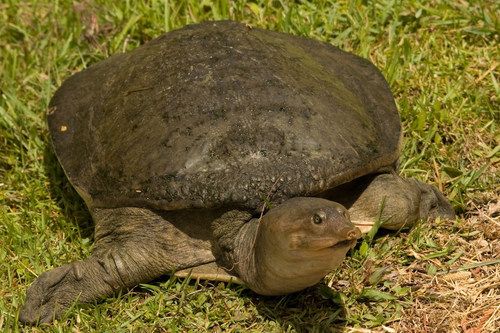
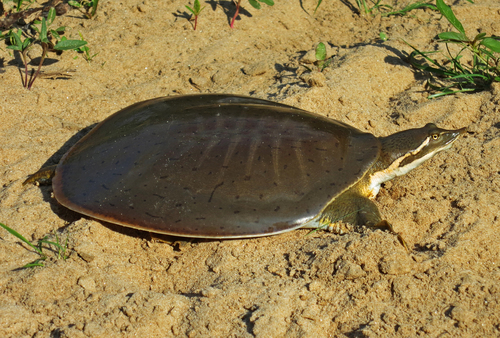
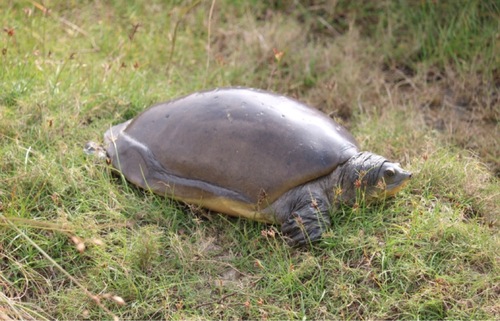
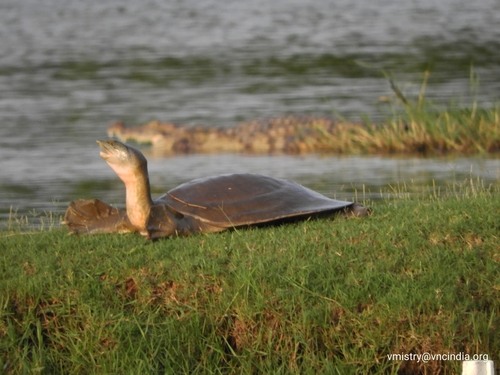
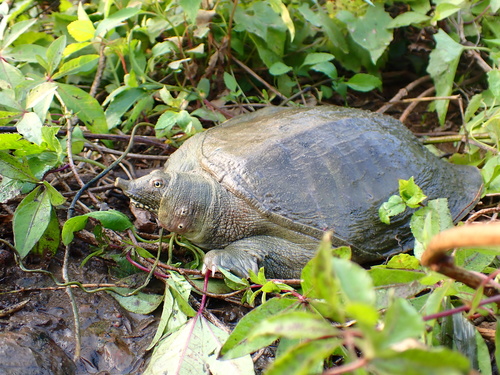
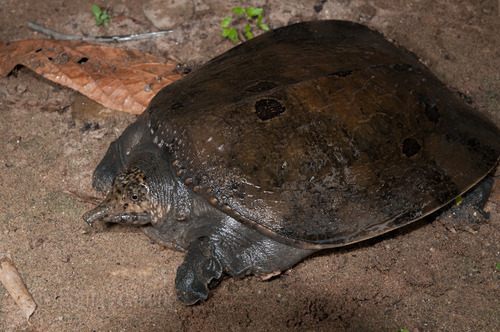
Amyda cartilaginea, commonly known as the Asiatic soft-shell turtle, has a shell that reaches 70 to 80 cm (27.6 to 31.5 inches) in length. Juvenile individuals have a rough-textured shell, while adult shells are soft and leathery. This is an average-sized turtle, with typical adult weights ranging from 15 kg (33 lbs) to 25 kg (55 lbs); there are unconfirmed reports of individuals reaching up to 105 kg (231 lbs). Its carapace is oval-shaped. Adult carapace color ranges from pale olive to green-brown, while juvenile carapaces are dark brown or black, and this dark color fades with age. Yellow dots and occasional black spots mark the shell, and these markings also fade as the turtle ages. The plastron shows sexual dimorphism: it is white in males and gray in females. The head can be black or brown, and typically has yellow dots that sometimes fuse into elongated streaks. As the turtle ages, its nape area turns white or gray. A noticeably elongated snout is a trait that distinguishes this species from other similar soft-shell turtles. This adaptation, combined with the turtle's great flexibility, helps it breathe when it is buried. An adaptation called pharyngeal breathing allows increased gas exchange, letting this turtle stay submerged in water for long periods of time. Amyda cartilaginea has several permanent tubercles on its neck, which can be yellow or black. The limbs also have yellow spots, but these are usually fewer in number and hard to tell apart. Its feet are wide and flat, and resemble paddles. Males have longer, thicker tails than females. Amyda cartilaginea is native to Brunei, Indonesia (Bali, Java, Sumatra, and Kalimantan), Malaysia (Sabah, Sarawak), Singapore, and southern Thailand. Its native range extends from the Thai section of the Malay Peninsula south throughout Island Southeast Asia. Populations in the Lesser Sundas, Moluccas, and Sulawesi are thought to be introduced or traded individuals. The species is found in tropical freshwater habitats within rainforest terrestrial biomes, and in aquatic biomes including lakes, ponds, canals, and lowland streams. It has been recorded across multiple locations in Asia, specifically in Brunei, Bangladesh, Borneo, Cambodia, India, Indonesia, Laos, Malaysia, Myanmar, Sabah, Sarawak, Singapore, Thailand, and Vietnam. Amyda cartilaginea prefers wetlands, and can be found in marshes, swamps, and large muddy rivers at low elevations. The Asiatic soft-shelled turtle follows a life cycle similar to many other turtles worldwide. It hatches from a clutch of eggs laid in sand along a body of water. Clutch size ranges from four to eight eggs, depending on the size and age of the female that laid the clutch. The average incubation period is between 130 and 140 days, though incubation length is heavily dependent on climate. Climate also influences the sex of most developing turtles: females typically develop at around 30 degrees Celsius, and males at 25 degrees Celsius. After hatching, young turtles must travel quickly to water to avoid predation. Monitor lizards, crows, and serpent eagles are known to prey on young Amyda cartilaginea. Juveniles that survive these early threats continue growing and developing into sexually mature adults. Females reach sexual maturity in around 20 months. Once sexually mature, Asiatic soft-shell turtles can produce up to four clutches of eggs per year, though this depends on annual conditions. Their mating cycle relies on the dry season, as this is the only time river banks are exposed enough for egg-laying. While it is known that Asiatic soft-shell turtles can live very long lives, the exact total length of their life cycle is not yet understood. This gap in knowledge is partially due to the fact that many Asiatic soft-shell turtles are caught for food, where larger and older individuals are more desirable because they produce more meat.