About Amyciaea forticeps (O.Pickard-Cambridge, 1873)
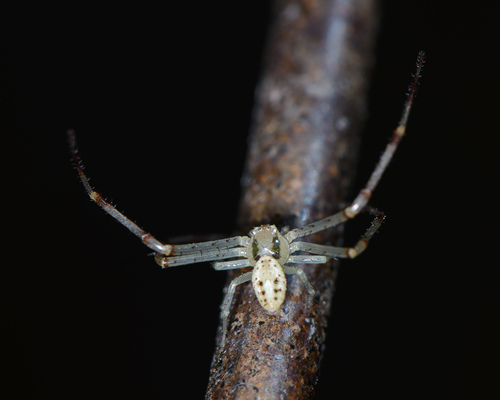
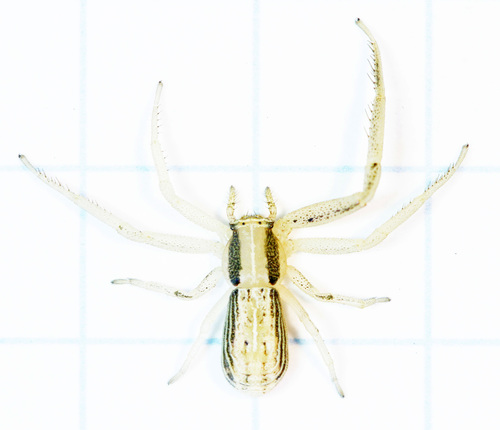
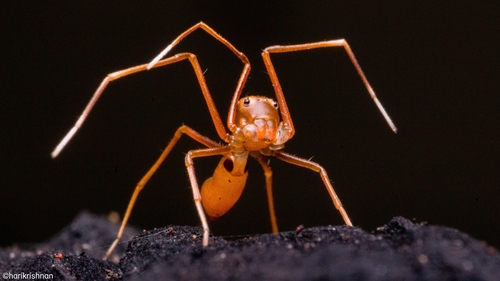
Amyciaea forticeps is a distinctive spider with an unusual appearance that has been called "Salticiform-looking", even though it belongs to the crab spider family. Males reach approximately 2¼ lines, or around 4.5 mm, in total length. When viewed in profile, the cephalothorax has a truncated look: the thoracic region is greatly shortened, and the caput is enlarged. Normal grooves and indentations on the cephalothorax are barely visible. The cephalothorax is colored orange-yellow, and bears a few erect black bristles inside the ocular area. Its eye arrangement is notable: the eyes sit on tubercles that are paler than the surrounding cuticle. The outer eye quadrangle is quite large, and the tubercles supporting these eyes are particularly prominent. This quadrangle is wider than it is long, and is nearly square in shape. The inner quadrangle is smaller, holding four very small eyes, but shares similar proportions with the larger outer quadrangle. The legs are long and slender, and are primarily orange-yellow. Only the tarsi and outer sides of certain joints are colored whitish cream. The second pair of legs is slightly longer than the first, while the third pair is by far the shortest. Each tarsus ends in two curved, pectinated claws. The pedipalps are short, and match the legs in color. The palpal organs are simple, and are surrounded by a black filiform spine. The abdomen is twice as long as the cephalothorax, and is narrow; its broadest section is the posterior portion, which is rather rounded. The abdomen is dull pale yellow, with blackish brown markings on its forward section and sides. These markings include transverse angular lines and curved oblique rows of pale spots, which are formed by small tufts of pale hairs. Amyciaea forticeps has a wide distribution across Asia, with recorded occurrences in India, China, and Malaysia.