About Amsinckia menziesii (Lehm.) A.Nelson & J.F.Macbr.
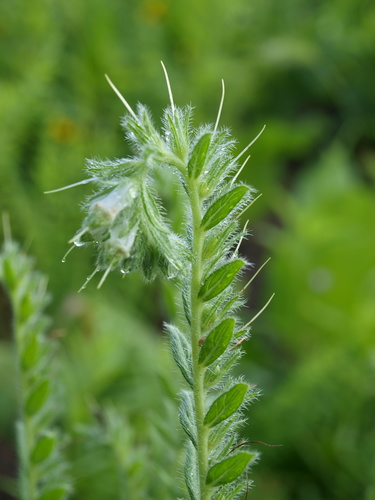
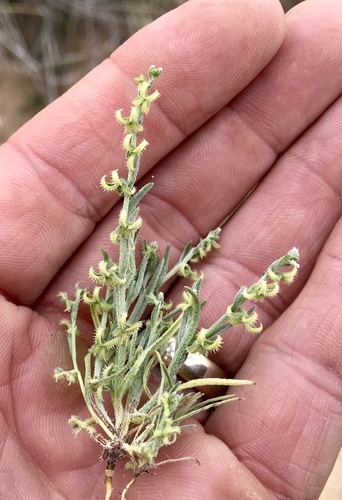
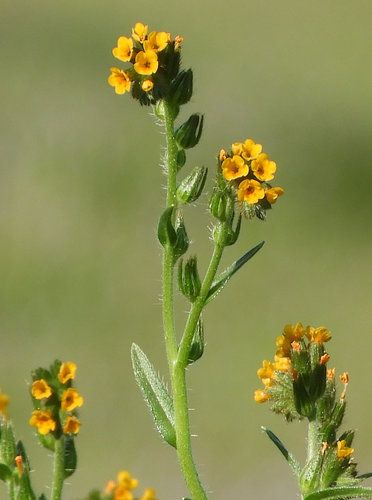
Amsinckia menziesii (Lehm.) A.Nelson & J.F.Macbr. grows up to 90 centimetres (35 inches) tall, and its stems are covered in bristly hairs. Its leaves reach up to 15 cm (6 in) in length, and range from narrowly to broadly lanceolate in shape. Coiled clusters of yellow-orange flowers bloom at the ends of branches from April to May; these coiled clusters resemble the end of a fiddle, which gives the plant its common name "fiddleneck". The flower calyx has five narrow lobes, and the corolla measures 3–10 millimetres (1⁄8–3⁄8 in) across. Its fused petals form a narrow funnel shape that flares outward at the opening. The plant produces grayish fruit that splits into four nutlets, each around 3 mm (1⁄8 in) long. This species is native to open areas ranging from Washington and Idaho east to Arizona, and south to Baja California. It has become a common weed of cultivated land in New South Wales, Victoria, and Queensland, Australia. It is an introduced, naturalized species in the British Isles, where it is especially common in eastern parts of the region and has been recorded growing wild there since 1910. The plant's seeds are inedible to humans because they contain high levels of pyrrolizidine alkaloids, but these seeds are the preferred food of Lawrence's goldfinch during the Californian bird's spring and early summer nesting season.