About Ampulloclitocybe clavipes (Pers.) Redhead, Lutzoni, Moncalvo & Vilgalys
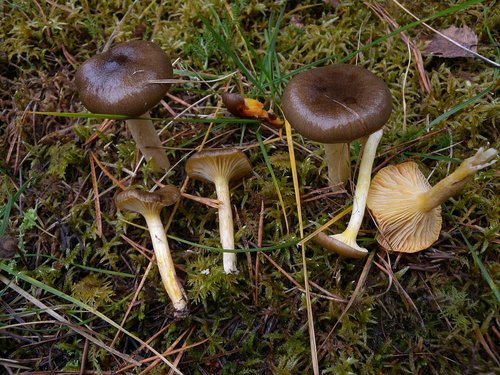
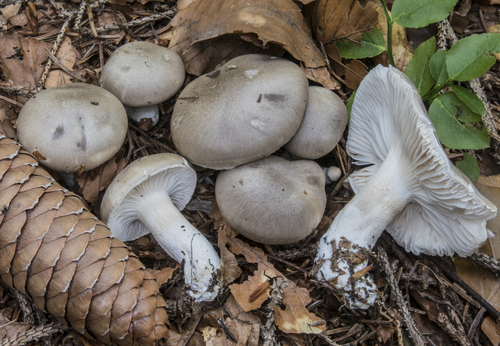
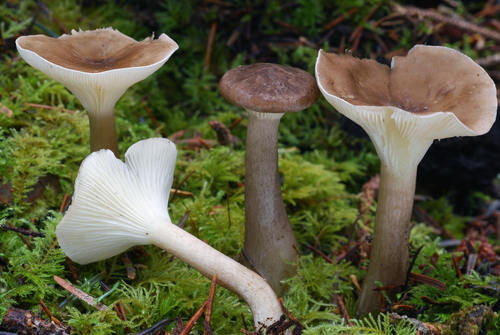
The cap of Ampulloclitocybe clavipes ranges from 4 to 8 centimetres (1 5/8 to 3 1/8 inches) in diameter. It starts out convex with a small raised central boss, and matures to a flat or depressed shape. The cap surface is smooth, often covered in fine fibrils, and is usually moist. Cap colour is generally grey-brown, sometimes with an olive tint, and has a pale margin. The stem is 3 to 7 cm (1 1/8 to 2 3/4 inches) tall and 1 to 1.5 cm (3/8 to 5/8 inch) wide, with a distinctly bulbous base. Its surface is covered in silky fibres, and matches the cap's colour. The thick flesh is white, with a slight yellow tint at the base. In the stem, the outer flesh is tough, while the central core is spongy and soft. The flesh is watery, and has a slightly sweet scent that has been compared to bitter almond, orange blossom, cinnamon, or grape bubble gum. The gills are strongly decurrent and cream-yellow in colour, creating a contrast with other parts of the mushroom. Smaller gills occur between the full-sized regular gills, and gills are occasionally forked near the stem. Young mushrooms have straight gill edges, while older mushrooms often have wavy, undulate gill edges. The spore print is white. Spores are round to oval, and measure 4.5–5 by 3.5–4 microns. This species is widespread and abundant across Northern Europe and the British Isles, and is becoming more common in these areas. In North America, it is common under pine plantations in the east, and less common in the Pacific Northwest. It grows in both conifer and deciduous forests, particularly under beech trees. In northern Europe, fruit bodies appear from August to November.