About Ampittia dioscorides (Fabricius, 1793)
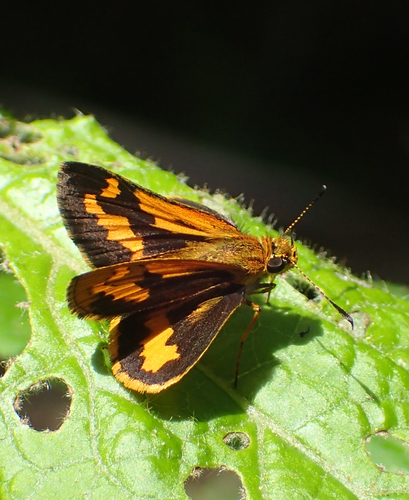
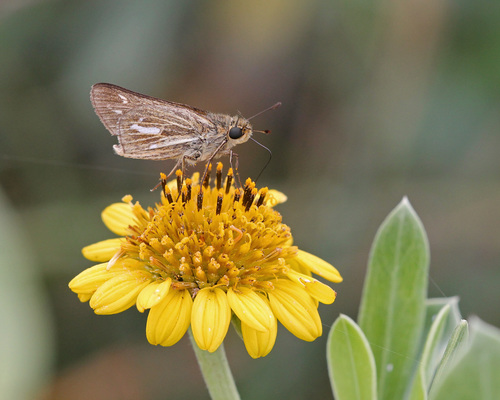
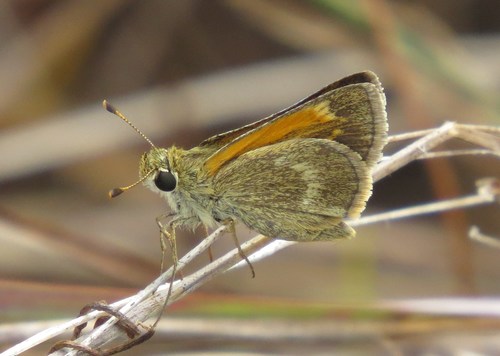
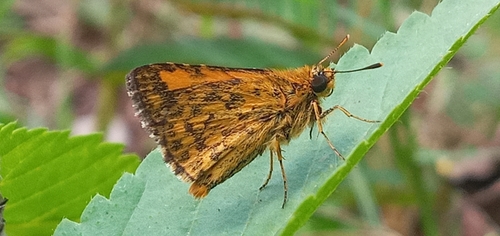
This species, Ampittia dioscorides, shows clear sexual dimorphism in wing patterning. Males have the following appearance: On the upper side of the forewing, the base color is bright golden-yellow. The costal edge is marked by a black line, and the outer margin has a broad, even black band that bulges slightly inward squarely at the hinder angle. There is a broad black band along the hinder margin that holds two golden-yellow spots: one positioned slightly before the middle, and the other slightly after the middle. A black band runs upward from the middle of the hinder marginal band to the costa, one-third of the way before the apex; this band extends a cross band from above its middle and connects to the outer marginal black band. In some specimens, this discal black band is disconnected from the costa starting at the crossbar. The upper side of the male hindwing is blackish-brown, with an irregular, short, broad discal golden-yellow band made of spots divided by wing veins. The two central spots in this band are elongated, while the lower spots are small. The cilia are brown, with patches of golden-yellow most noticeably at the anal angle. On the underside: the forewing matches the patterning of the upper side, except the extreme outer margin is more or less golden-yellow. The underside of the hindwing has a golden-yellow base color, with most of the wing covered in tiny brown scales. The discal patch matches the one on the upper side, is edged with pale brown, and a series of pale brown submarginal spots circles the entire wing from the base to the anal angle. Male antennae are black with yellow rings; the club is yellow on the underside and at the tip. Male palps, head, and body are brown on the upper side; the palps and head have yellow markings, and all of these structures are entirely yellow on the underside. Females have a dark brown upper side base color. On the female forewing upperside, there is a yellow spot at the end of the cell, plus a discal series of yellow spots: two, occasionally three, spots divided by veins starting near the costa one-sixth of the distance from the apex, two spots in the middle of the disc within the median interspaces, and one small spot in the interno-median interspace. There is also an indistinct series of submarginal yellowish spots on the upper half of the wing. The underside of the female wings is paler than the upper side. On the female forewing underside, the spots match the upper side pattern but are larger, and a yellow sub-costal streak runs from the base to beyond the middle of the wing. The female hindwing has scattered patches of many tiny yellow scales, with a discal series of yellowish spots and a separate submarginal series of spots.