About Amphiuma means Garden, 1821
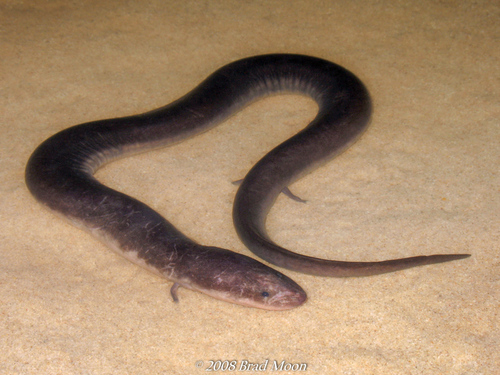
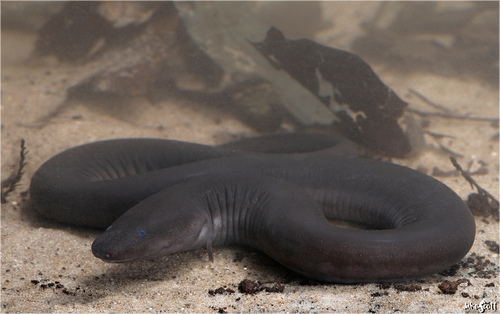
Two-toed amphiumas (Amphiuma means Garden, 1821) are the largest prominent member of the Amphiumidae family, and the longest salamander species found in the United States. Their mass ranges from 39 to 1,042 g (1.4 to 36.8 oz), and their length ranges from 34.8 to 116 cm (13.7 to 45.7 in). They have four vestigial legs, each ending in two toes; toe count is one of the primary differences that separate this species from its relatives, the one-toed and three-toed amphiumas. Additional genetic studies have been carried out on all three amphiuma species. Estimates of genetic distance indicate high levels of similarity between two-toed amphiumas and three-toed amphiumas, with much greater genetic dissimilarity between one-toed amphiumas and two-toed amphiumas. Two-toed amphiumas have a pointed, wedge-shaped head and small eyes. Adult individuals retain a single gill slit on each side of the head. Their base coloration is black, dark grey, or dark brown, and individuals are typically unicolored. Their dark dorsal side contrasts with their slightly lighter ventral side. Two-toed amphiumas inhabit shallow, heavily vegetated water bodies including swamps, bayous, lakes, and ponds, as well as wet prairies. They are most often found below the fall line, but occasionally occur in low sandy pine hills. Their microhabitats largely overlap with areas of high prey availability. They require habitats with light soil that allows them to burrow. Their natural range covers southeastern Virginia, eastern North Carolina, South Carolina, southern Georgia and Alabama, Florida, southern Mississippi, Arkansas, Louisiana, and southeastern Texas.