About Amphistichus rhodoterus (Agassiz, 1854)
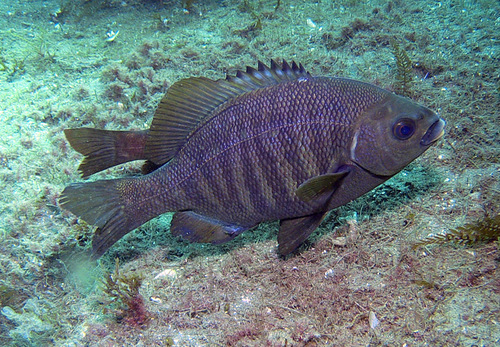
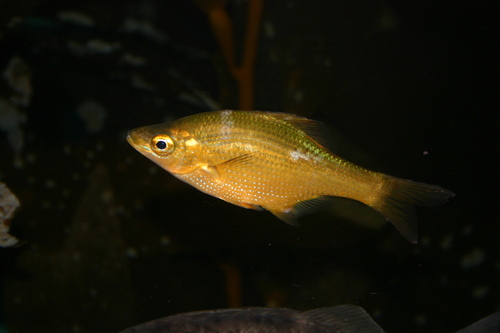
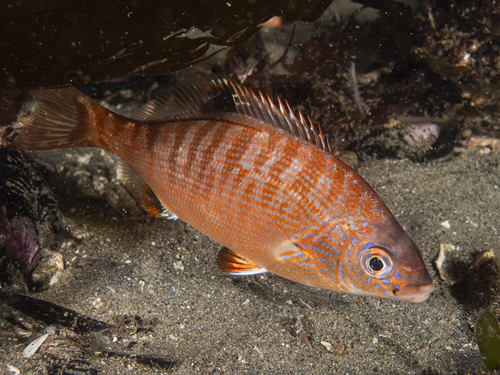
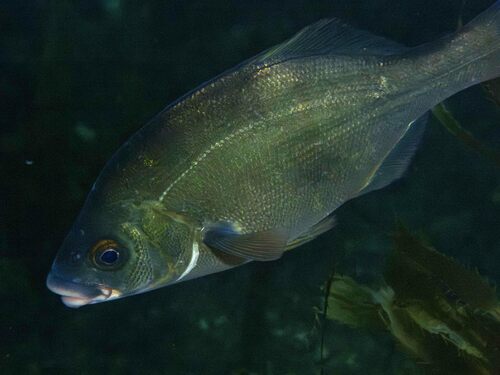
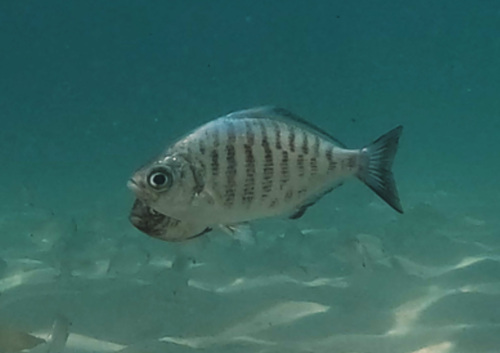
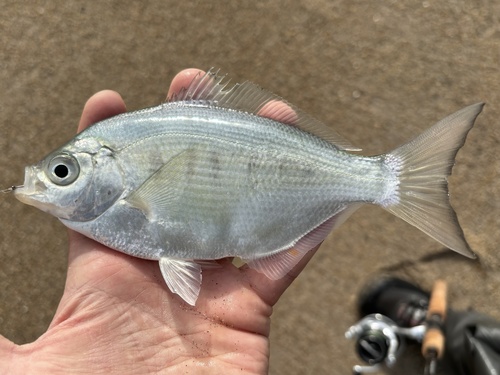
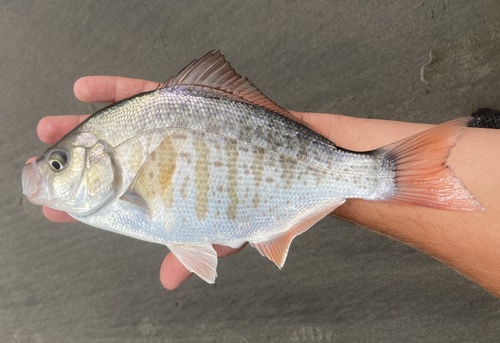
Redtail surfperch (Amphistichus rhodoterus) are deep-bodied fish that are oval when viewed from the side, and compressed (slender) from side to side. Most observed individuals measure between 8 and 11 inches long. Their bodies are light-colored, ranging from white to silver, and marked with vertical bars. Their dorsal, anal, and tail fins are red or pink. When the fish are young, these vertical markings are distinct bars, but they become less distinct olive-red-brown markings as the fish grows. All of the redtail surfperch's fins contain both spines and fin rays, and the tail is moderately forked. The longest dorsal spines of this species are longer than the dorsal fin rays, a trait that distinguishes it from the closely related barred surfperch (Amphistichus argenteus) and calico surfperch (Amphistichus koelzi). Excluding the mildly forked tail, a redtail surfperch's body is roughly twice as long as it is high. The tail makes up about one quarter of the fish's total length, and is as wide as it is long. The first quarter of the fish's total length holds the small upturned mouth, eye, and gill cover. The second quarter contains an upward-sloping back, the dorsal fin spines that run along the highest part of the back, a pectoral fin at the leading edge of the lowest part of the belly, and a moderately sized pectoral fin located two-thirds of the way down the body just behind the gill cover. The third quarter of the body holds the dorsal fin rays, the anus, and the start of the anal fin. After the anus, the redtail surfperch's belly slopes upward. The posterior (final) quarter of the fish contains the upward-sloping end of the anal fin and the forked tail. The lateral line starts behind the gill cover, runs high along the back parallel to the body edge above the pectoral fin, and extends all the way to the tail. When fins are extended, they can change the overall outline or profile of the fish significantly. Redtail surfperch are common year-round along sandy ocean beaches and jetties. They move into upper estuary bays seasonally, most commonly during spring. Their distribution ranges from Avila Beach, California to Hope Island, British Columbia. This is the only New World marine surfperch species that does not inhabit the waters of Southern California and Baja California. Like other surfperch, redtail surfperch are viviparous, meaning they give birth to live young. Amphistichus rhodoterus are also iteroparous, meaning individuals reproduce multiple times throughout their lives. Females give birth annually once they reach sexual maturity at 3 to 4 years of age. For females along the central Oregon coast, fertilized eggs are present around the start of the year, gestation lasts 8 months, and birth takes place in August and September. Populations in Northern California follow a similar reproductive schedule, but parturition (live birth) begins as early as July. A female redtail surfperch typically gives birth to between 3 and 40 young, and there is a strong correlation between female size and the number of offspring produced. In laboratory settings, some young do not develop fully inside the female, and may be reabsorbed or stillborn. Wild-caught fish rarely carry abnormal embryos. Water temperature affects embryo growth, timing of birth, and size at birth, and may be linked to the faster growth observed in female redtail surfperch. As mature males develop, they develop a distinctive permanent shortening of some anal fin rays. This shortening creates a notch when viewed in profile, allowing external identification of mature males from females and juvenile fish.