About Amphistichus argenteus Agassiz, 1854
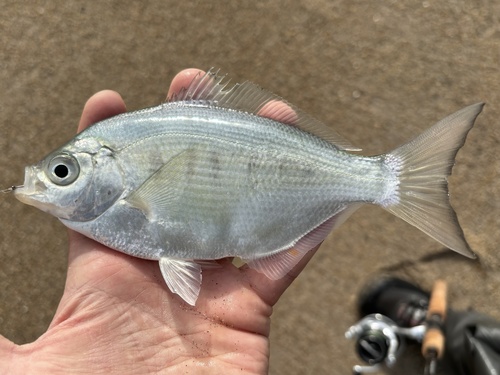
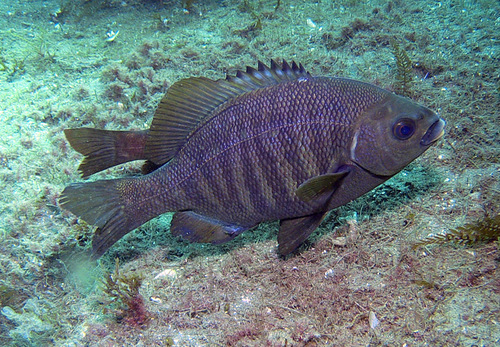
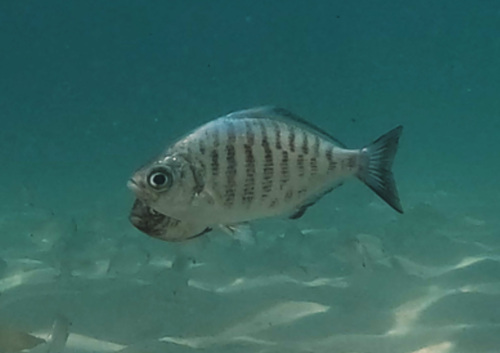
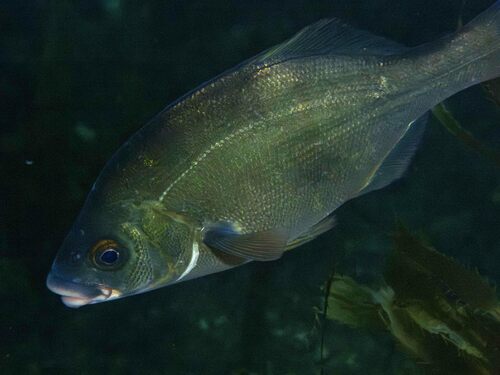
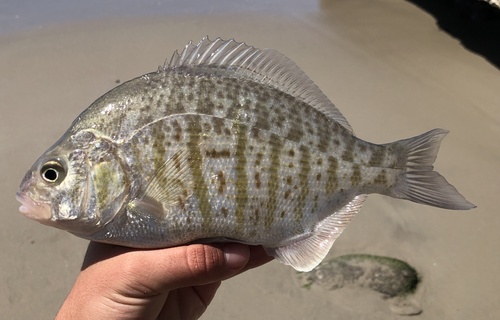
This species, commonly called barred surfperch, is a relatively deep-bodied, oval-like fish with a slender frontal profile. Its back ranges from darker yellow to olive green, and its belly is white. Most individuals have 9 vertical bronze bars on their sides, with small spots between the bars; the bars are split across the lateral line. A non-barred, solid golden body variant is also common. Barred surfperch have a single connected dorsal fin with 9 to 11 spines and 19 to 28 longer soft rays, while the anal fin has 15 to 35 soft rays. The lower jaw protrudes less than the upper jaw, and does not extend past the eye. This species can reach a total length of 49.5 cm (19.5 in), though most individuals do not exceed 30 cm (12 in) total length. The maximum recorded weight for this species is 2.15 kg (4.7 lb), making it the largest surfperch by length and the second largest by weight. Individuals likely do not live longer than 10 years. Per the California Department of Fish and Game, barred surfperch can be identified by the bars and spots on their sides (though many individuals are unbarred), and by the absence of a red tail. Barred surfperch have a geographic range extending from Guerrero Negro in Central Baja California to Northern California, and are rarely seen north of Bodega Bay. They most often live in shallow surf zone waters less than 5 m (16 ft) deep, but have also been found at depths up to 73 m (240 ft). They are frequently found along sandy beaches longer than 1 km (0.62 mi), but also occur in enclosed "pocket beaches" within coves. They may occasionally be found above rocky substrates, near pier pilings, or in bays. Like other surfperch, barred surfperch are viviparous and give birth to live young. They mate in winter, most often between September and November, and may move closer to shore to mate. They give birth to numerous fully developed, free-swimming fry that measure 51–76 mm (2.0–3.0 in) long. A female can carry over 100 embryos at one time, and the number of young produced depends on the size of the mother.