About Amphipterygium adstringens (Schltdl.) Schiede ex Standl.
Amphipterygium adstringens, commonly called cuachalalate, is an ancient medicinal plant that has been commercially used in Mexico for centuries. Due to its rising popularity and high demand for its bark, it was classified as an endangered species as of 2004.
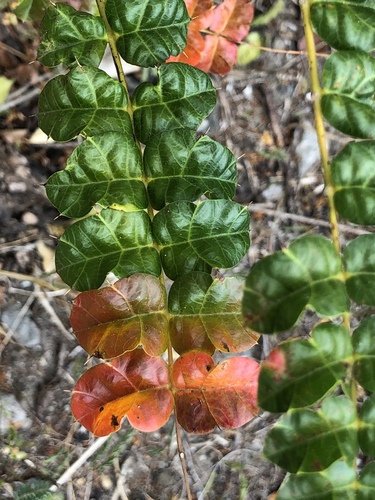
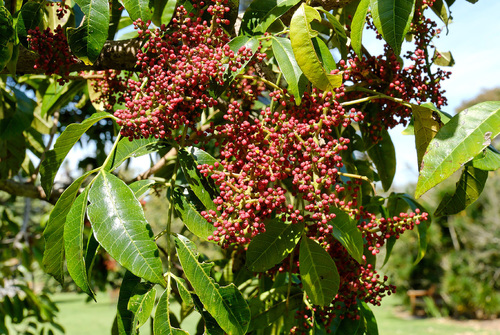
This tree reaches a height between 4 and 8.5 meters. Its most distinctive feature is its bark, which is wrinkled, grayish, verrucose, and marked by corky protuberances. Its branches are typically covered with scars from fallen leaves, and may be hairless or covered in fine hair-like structures. Leaves are arranged in an imparipinnate pattern, with petioles that average 5.4 cm in length. Each leaf usually bears 3 to 7 leaflets. These leaflets have a cuneate base, an obtuse or rounded apex, and dentate or crenate margins. A. adstringens can be distinguished from other species in the Amphipterygium genus by its spathulate terminal leaflets, which only have dentate margins on their distal half.
A. adstringens is distributed across central and southern Mexico, where it grows in deciduous forests near mountain and Pacific slope regions. Its confirmed range includes south-central Jalisco, Michoacán, Morelos, Estado de Mexico, Puebla, Guerrero, and Oaxaca. It typically blooms in summer, from June to August, and produces fruits from August to January. It grows in warm conditions in deciduous jungles, or in Quercus and Ilex forests.
In Mexican traditional medicine, cuachalalate is a legendary plant believed to have curative effects. Its bark is the most sought-after part of the plant, and it is popularly believed to cure malaria, stomach cancer, gastric ulcers, and kidney diseases. Many people in Mexico also use cuachalalate bark to harden the gums.