About Amphipsalta zelandica (Boisduval, 1835)
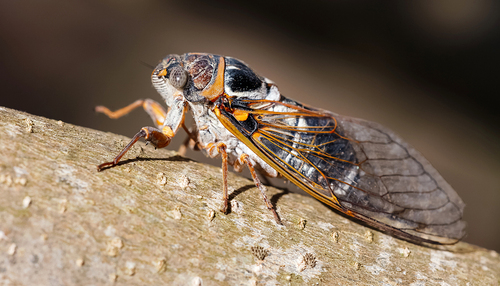
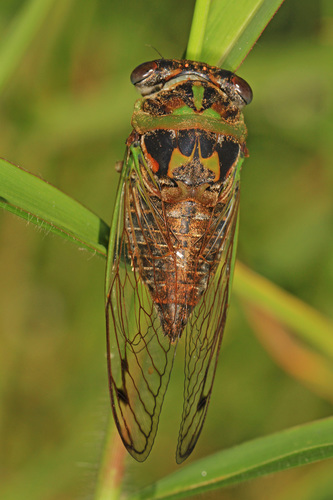
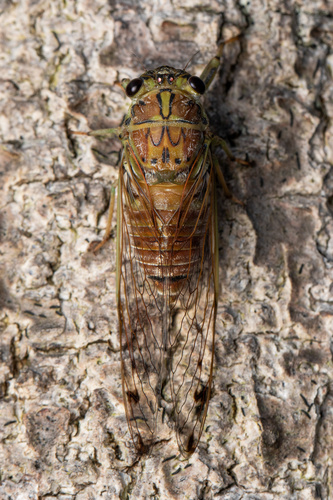
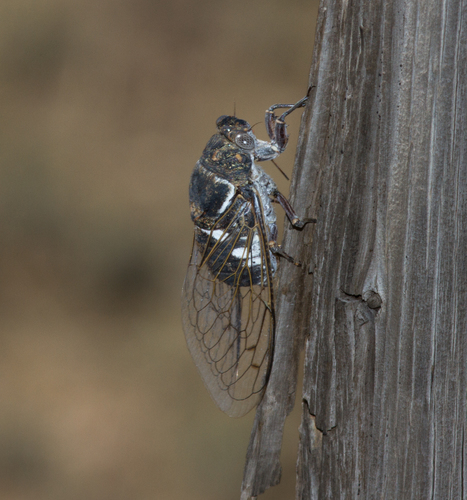
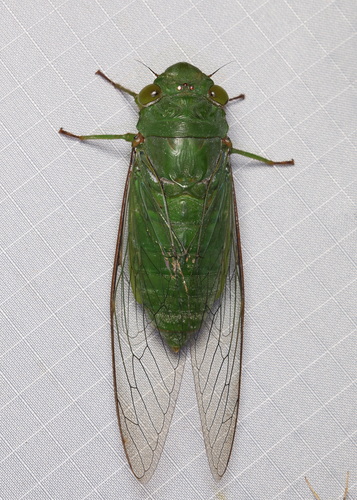
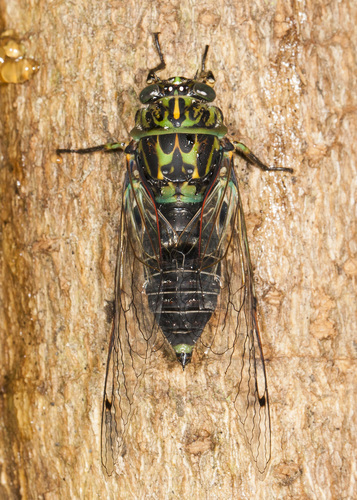
Amphipsalta zelandica, commonly known as the chorus cicada, has a nymph stage before its final molt into adulthood. During the nymph stage, individuals are soft and creamy white, and closely resemble the adult form, though they lack wings. Adults are usually over 2 cm in length including the wings, and the largest individuals reach up to 4 cm; chorus cicadas are New Zealand's largest cicadas, with an average size of 40 mm. Wings only develop after molting into adulthood; they are membranous, veined, filter ultraviolet light, and have an average wingspan of around 6 cm. Chorus cicadas can be black, green, or brown in color, and many have stripes running along their bodies. Their antennae have seven segments, and the seventh segment is constricted at its midpoint. Adult males can be distinguished from females by the presence of a clasper sheath, and females lack the finger-like extensions that males have. The song produced by cicadas is the loudest noise made by any insect. Male chorus cicadas produce a species-specific communication song, which allows the species to be identified by song alone. A pulse group of the chorus cicada's song consists of five clicks, with the central third click being stronger than the two clicks on either side of it. If the cicada is tired and lacks energy, this central click may split into two separate clicks. These clicks are produced when the cicada strikes its wings against the surface it is perched on. During collective chorus singing, these pulse groups can be produced quickly and continuously to form a prolonged note. Chorus cicadas are endemic to New Zealand. Their closest related species live in Australia, New Caledonia and Norfolk Island. Studies of New Zealand's fauna indicate that New Zealand's insect fauna originated from multiple invasions across the Tasman Sea from Australia or New Caledonia. Within New Zealand, chorus cicadas are commonly found in towns and cities. They are distributed across the entire country, and are common in the North Island, some coastal areas of the South Island, central Otago, and parts of Canterbury. Their most common habitats are open forests and woodlands, but they are sometimes also found on buildings, fences, and lamp posts. They prefer subtropical, sub-humid, and temperate environments. Mating is triggered by male song, which brings together large numbers of males and females. Males compete with one another to produce the loudest and highest-quality song, and sing more loudly when the weather is warmer. Occasionally, two cicadas will fight each other. Chorus cicadas usually mate silently on tree trunks. Adult cicadas have a short lifespan of only two to three weeks, as adults die after mating. Female chorus cicadas lay eggs in the thin branches of a wide variety of plants. A female lays between 5 and 700 eggs, each around the size of a grain of rice. Eggs are laid in a herring-bone pattern within thin tree branches. Eggs take 3 to 10 months to develop before hatching, which occurs between May and mid-December. After hatching, larvae burrow into the ground, where they grow, develop their organs, and increase in size. This growth process and transformation into nymphs takes place through spring and winter months. During their underground period, nymphs feed on juice from plant roots and other underground organisms. The nymph stage can last between 25 and 44 months. Once nymphs reach their maximum size, they emerge from the ground and climb tree trunks to molt, transforming into adult cicadas. This emergence and molting takes place on summer nights between mid-December and late February. After emerging from their final nymph exoskeleton, the cicada's wings expand, and the cicada waits for the wings to harden before flying away. The median total lifespan from egg to natural adult death is around four years. In Māori culture, chorus cicadas are known by the names kihikihi wawa, matua kihikihi, and ngengeti. The Māori haka and folk song Te Tarakihi (the cicada) is based on the cicada's shrill summer singing.